

The Quick Clarification: “PoE” and “Channel Count” Are Different Layers
Before comparing performance, it helps to separate two ideas that are often mixed together:
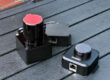
- PoE (Power over Ethernet) describes how the device is powered and connected—one Ethernet cable for power + data.
- Single-channel vs multi-channel describes the LiDAR emitter/receiver beam count (single-line 2D scanning vs multi-beam 3D point clouds).
You can have PoE on both types. PoE changes deployment and infrastructure planning; channel count changes what the sensor can “see” and how much data it produces.

1) Sensing Dimension and Coverage: 2D Slice vs 3D Volume
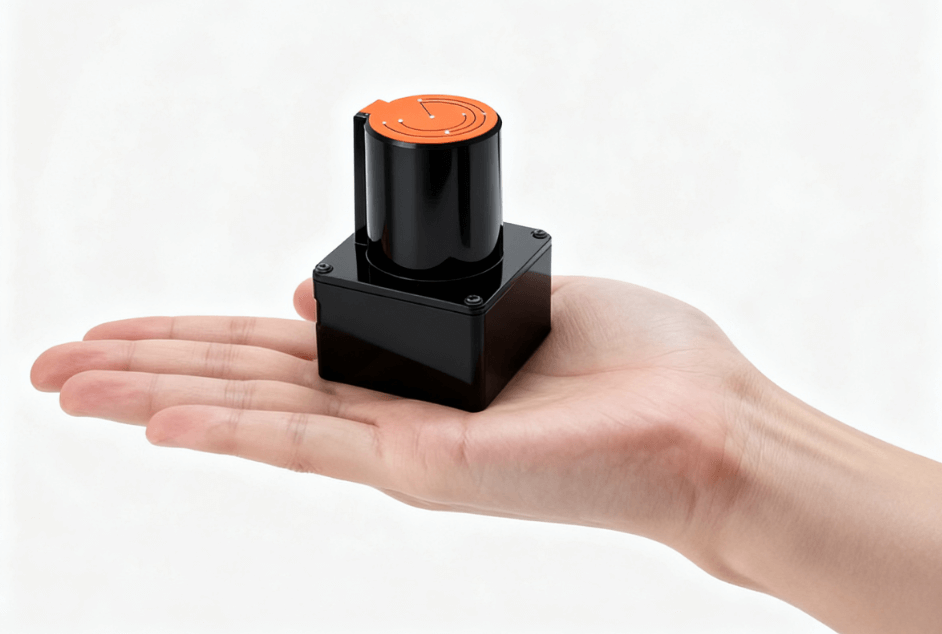
Single-channel PoE LiDAR (typically 2D scanning)
A single-channel unit commonly produces a single scanning plane—one laser line sweeping across a field of view through rotation or oscillation.
What that means in practice:
- You get distance points in one 2D cross-section (horizontal plane or a tilted plane).
- It is excellent for tasks where the world can be simplified to a plane: footsteps on a floor zone, hands on a wall zone, a doorway line, or a corridor slice.
Best-fit use cases:
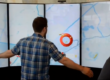
- interactive floor/wall projection
- access gate/passage detection
- planar people counting / direction detection
- basic intrusion detection in a defined 2D zone
Multi-channel LiDAR (16/32/64/128 beams, etc.)
Multi-channel LiDAR stacks multiple beams vertically. A single rotation yields a 3D point cloud, capturing not just where something is, but its height profile across a larger vertical field of view.
Best-fit use cases:
- 3D mapping (SLAM), robotics navigation
- high-end security with height-based filtering
- complex environments with stairs, slopes, multi-level occlusions
- 3D reconstruction / digital twin capture
Bottom line:
Single-channel is like a precise 2D measuring slice. Multi-channel is a dense 3D scanner.
2) Point Cloud Density and Detail: Enough Points vs Rich 3D Structure
Single-channel (2D)
Because it produces one scan line per rotation, the point set is:
- lower overall point count
- concentrated on one plane
- very efficient for “where is the contact point / crossing event / target position in 2D?”
If your application only needs:
- footstep location
- touch points
- whether someone crossed a line
- where movement occurs inside a zone
…then single-channel often provides all the detail you can use, without flooding your system with unnecessary data.
Multi-channel (3D)
Channel count increases vertical sampling. At the same rotation speed:
- point count scales up dramatically
- small objects are easier to detect
- targets can be separated by height (e.g., legs vs torso vs head)
- occlusion handling improves in many real-world scenes
If you need 3D target segmentation and “what is it?” logic, multi-channel wins clearly.
Bottom line:
Multi-channel dominates when you need high point density and 3D separation. Single-channel dominates when you want clean 2D interaction data at a practical cost.
3) Range, Accuracy, and Refresh Rate: What Actually Changes (and What Doesn’t)
A common misconception is that “more channels = more accurate.” In reality:
- Distance accuracy and repeatability depend heavily on the ranging method (ToF), optics, and sensor electronics—not automatically on channel count.
- Many multi-channel units are positioned as premium products, so they often come with better components, longer range, and higher point rates—but that’s a product tier effect, not a physics rule.
For typical interactive projection and people sensing (roughly 0–20 m):
- single-channel PoE LiDAR often delivers centimeter-level repeatability and 20–30 Hz class updates, which is usually sufficient for real-time effects, multi-person interaction, and counting.
Bottom line:
If your use case is mid-range interaction and detection, single-channel is frequently “accurate enough.” If you need long-range or high-speed 3D perception, multi-channel products are more common in that class.
4) Algorithms and System Complexity: Lightweight 2D Logic vs Full 3D Pipelines
Single-channel PoE LiDAR: simpler processing
2D scan lines can often be handled with:
- thresholding and geometry rules
- basic clustering
- lightweight tracking
- simple “enter/exit” state machines
For interactive projection, the integration is straightforward:
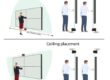
- calibrate the LiDAR plane to the projection plane
- output events as touch points (mouse emulation, multi-touch, TUIO, UDP, etc.)
- render effects in the correct coordinates
Compute and bandwidth requirements are typically modest.
Multi-channel LiDAR: heavier 3D processing
3D point clouds frequently require:
- filtering and downsampling
- ground removal / plane fitting
- clustering in 3D
- 3D object detection and tracking
- more storage, bandwidth, and compute
That power is valuable—but for many interactive walls/floors and basic counting projects, it’s simply beyond what the application needs.
Bottom line:
Single-channel is easier to integrate and maintain. Multi-channel unlocks advanced capabilities but raises algorithmic and operational complexity.
5) Cost, Power, and Scaling: One Zone vs Many Zones
Single-channel PoE LiDAR: scalable and budget-friendly
- simpler optics and fewer channels typically mean lower cost
- lower power draw makes PoE deployment easier
- realistic for multi-point installations (multiple zones, corridors, modular expansions)
This is why single-channel is common in:
- interactive playgrounds
- exhibition halls with multiple experiences
- retail environments with several entrances/zones
Multi-channel LiDAR: fewer nodes, higher value per node
- higher unit cost and typically higher power requirements
- better suited to select high-value positions rather than large-scale tiling
- common in robotics, advanced security, or 3D capture systems where each sensor is a major perception node
Bottom line:
Single-channel is ideal for “many zones at reasonable cost.” Multi-channel is ideal for “fewer nodes with maximum 3D insight.”
How to Choose: A Practical Decision Checklist
Choose PoE single-channel (2D) when you need:
- interactive projection (floor/wall/AR sandbox)
- doorway counting, passage sensing, queue triggers
- planar intrusion or zone entry detection
- multi-user interaction based on 2D touch points
- fast deployment, simple integration, low operational overhead
- the ability to scale across multiple areas without blowing up budget
Consider PoE multi-channel (3D) when you need:
- height-aware perception (stairs, slopes, multi-level scenes)
- 3D target recognition and classification
- robust separation of objects at the same horizontal position but different heights
- 3D mapping, robotics navigation, or reconstruction
- you have budget and compute capacity for 3D processing
Summary
- PoE single-channel LiDAR: efficient 2D sensing for interaction, counting, and zone detection—lower cost, easier integration, great for multi-zone deployments.
- PoE multi-channel LiDAR: rich 3D point clouds for advanced perception and height-aware scenarios—higher cost, higher complexity, best for high-value 3D applications.