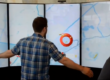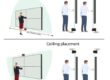

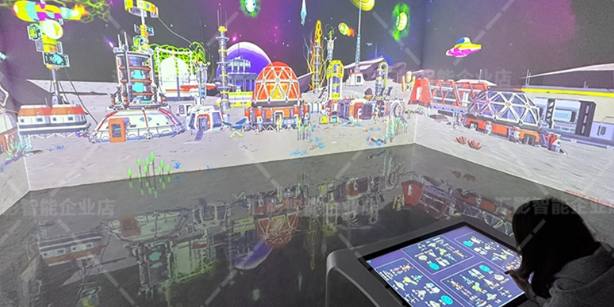
Interactive wall projection is a digital interaction system where people walking, waving, or touching in front of a wall cause real-time visual changes—such as particles scattering, flowers blooming, buttons triggering animations, or sound effects responding instantly.
This technology creates a strong sense of participation and immersion, making it widely used in shopping malls, museums, exhibitions, schools, hospitals, and entertainment spaces.
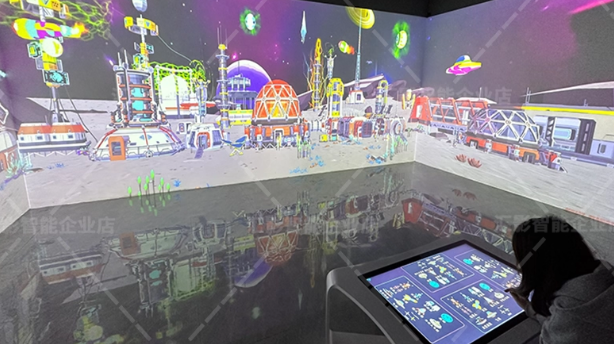
How Interactive Wall Projection Works
From a system and engineering perspective, interactive wall projection follows a closed-loop process of human action → sensing → visual feedback.
1. Motion and Touch Capture
The system detects user movement, gestures, or touch-like behavior in front of the wall using sensors such as:
- Cameras
- Infrared sensors
- Radar
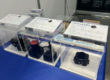
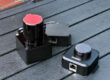
- LiDAR / PoE LiDAR
These devices convert physical actions into coordinates, motion trajectories, or trigger events.
2. Data Analysis and Mapping
Interactive software analyzes the incoming data in real time and maps it to specific on-screen elements—such as:
- Buttons
- Particles
- Flowers
- Game objects
Each movement or touch activates corresponding animations and sound effects.
3. Projection or LED Display Output
Projectors or LED screens display the interactive content on the wall, completing a seamless loop of human interaction and visual response.
Common Technical Approaches for Wall Interaction
Traditional Camera & Infrared Solutions
This approach uses cameras and infrared sensors to identify body outlines or touch zones.
Advantages
- Mature technology
- Lower initial cost
- Suitable for basic wall interactions
Limitations
- Sensitive to strong ambient light
- Accuracy decreases on large walls
- Limited multi-user performance
Often used in standard shopping malls and exhibition walls.
LiDAR / PoE LiDAR Interactive Wall Solutions
LiDAR-based systems use laser scanning to precisely measure hand and body positions in front of the wall.
With PoE (Power over Ethernet), a single network cable provides both power and data, making installation cleaner and more flexible.
Key advantages
- High-precision positioning
- Strong resistance to ambient light
- Excellent multi-point and multi-user support
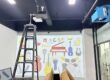
- Hidden ceiling or side installation
This solution is ideal for large interactive walls, LED walls, and high-end immersive spaces.
Key Features of Interactive Wall Projection
Strong User Engagement
Visual elements respond instantly to gestures, footsteps, or touch, making it easy to:
- Attract attention
- Encourage participation
- Create “check-in” and photo-worthy moments
Rich Visual Themes
Interactive wall projection supports a wide range of content styles, including:
- Ocean and water effects
- Starry sky and cosmic themes
- Flower fields and nature scenes
- Technology particles
- Educational quizzes and interactive games
This versatility allows deployment across commercial, educational, and public environments.
Low Space Requirements
Only three basic conditions are needed:
- A suitable wall or LED screen
- Adequate projection distance (or LED installation)
- A ceiling or side position for sensor installation
This makes interactive wall projection feasible even in compact or existing spaces.
LiDAR vs Traditional Wall Interaction Technologies
| Technology | Accuracy | Multi-User Support | Light Resistance | Large Wall Suitability |
|---|---|---|---|---|
| Camera Vision | Medium | Medium | Low | Medium |
| Infrared Sensors | Medium | Limited | Low | Medium |
| LiDAR / PoE LiDAR | High | High | Very High | Excellent |
For projects that demand stability, scalability, and premium experience, LiDAR-based interaction is increasingly the preferred choice.
Why Choose CPJ ROBOT for Interactive Wall Projection?
CPJ ROBOT is a professional manufacturer specializing in interactive LiDAR systems and reception robots, providing:
- LiDAR and PoE LiDAR interactive sensors
- Interactive wall and projection solutions
- Integration with welcoming and service robots
- OEM / ODM customization
- Stable hardware and professional interactive software
- Global deployment and technical support
With strong expertise in LiDAR sensing, robotics, and interactive system integration, CPJ ROBOT delivers reliable, scalable solutions trusted by integrators worldwide.
Frequently Asked Questions (FAQ)
Q1: Is interactive wall projection suitable for high-traffic areas?
Yes. Especially with LiDAR-based systems, interactive walls can support multiple users simultaneously without performance degradation.
Q2: Can interactive wall projection work with LED screens?
Yes. Interactive content can be displayed on both projection walls and LED screens, with LiDAR providing stable interaction even under strong brightness.
Q3: Does lighting affect the interaction accuracy?
Camera and infrared systems can be affected by strong light, but LiDAR interaction is highly resistant to ambient and stage lighting.
Q4: Can the content and interaction logic be customized?
Absolutely. Visual themes, interaction rules, detection range, and system layout can all be customized through OEM/ODM services.
Q5: Is interactive wall projection safe for public use?
Yes. LiDAR systems operate at low-power, eye-safe laser levels and comply with international safety standards.
Looking to build an interactive wall projection, immersive exhibition, or smart interactive space?
CPJ ROBOT is a trusted interactive LiDAR and reception robot manufacturer, offering:
- LiDAR / PoE LiDAR interactive solutions
- Interactive projection systems
- OEM / ODM customization
- Global agent and distributor opportunities
Contact CPJ ROBOT today to start your interactive wall project or join our global partner network.
- What Is LiDAR Interactive Projection? A Complete Guide to Its Applications in Modern Exhibition Halls
- What Is LiDAR Interactive Projection? A Complete Guide to Its Applications in Modern Exhibition Halls
- Advantages of Interactive Projection in Multimedia Digital Exhibition Halls
- Three Common Types of Interactive Wall Projection in Modern Exhibition Halls
- The Future of Dining — Inside the Interactive Projection Restaurant Revolution