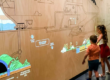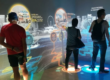

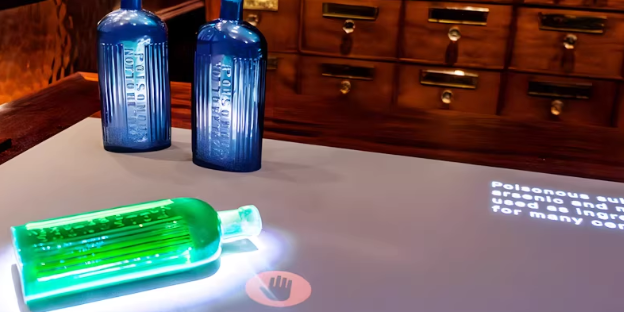
A desktop interactive projection table combines a projector with an “invisible touch” sensing system to transform an ordinary table into a multi-touch, gesture-responsive interface. Users can tap, drag, zoom, rotate, and collaborate directly on the tabletop surface.
This technology is widely deployed in restaurants, museums, exhibition halls, retail pop-ups, and children’s spaces, delivering immersive engagement without requiring a traditional touchscreen display.
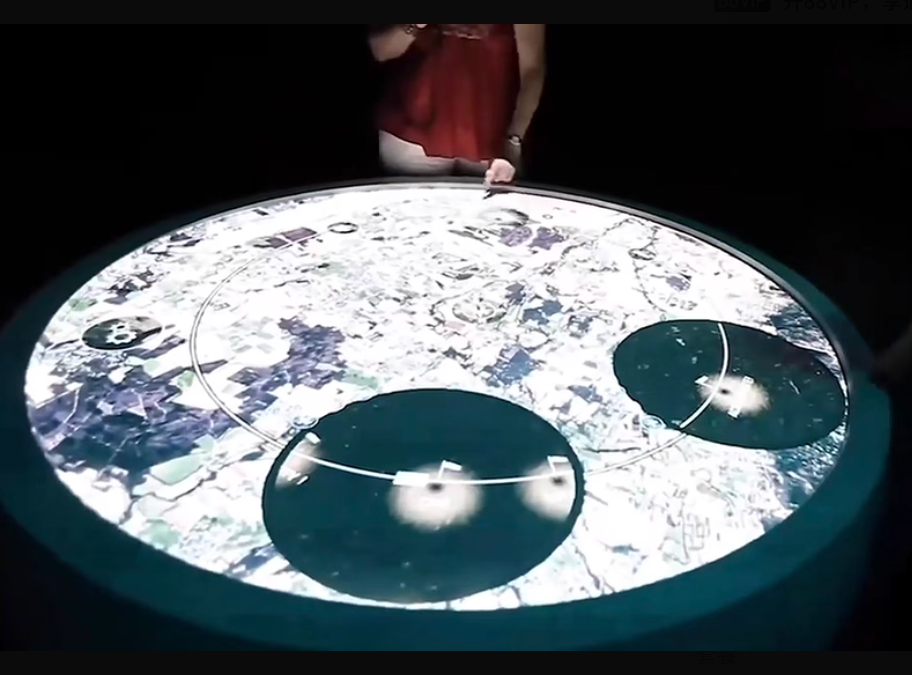
1. How a Desktop Interactive Projection System Works
An interactive projection table typically consists of three core components:
1.1 Projection System
A projector (standard, short-throw, or ultra-short-throw) casts digital content onto a flat surface such as a table or custom platform.
Key considerations:
- Lumens (brightness for ambient light conditions)
- Throw ratio (for compact installations)
- Resolution (Full HD or 4K for detailed visuals)
1.2 Touch & Gesture Sensing (The “Invisible Touchscreen”)
The sensing layer captures user interactions in real time using:
- LiDAR (Light Detection and Ranging)
- Infrared (IR) cameras
- 3D depth cameras
- Capacitive embedded panels (for integrated systems)
Among these, PoE LiDAR-based sensing is becoming increasingly popular for scalable commercial deployments because it enables:
- High precision spatial tracking
- Multi-touch and multi-user recognition
- Low-latency response
- Clean ceiling-mounted installation
- Single-cable deployment (Power over Ethernet)
1.3 Interaction Software Engine
Custom middleware translates spatial coordinates into UI commands such as:
- Click / tap
- Drag & drop
- Two-finger zoom
- Object rotation
- Gesture-based triggers
Advanced systems can also recognize:
- Hand shapes
- Object placement
- Multi-user separation
- Behavioral analytics
2. Interaction Methods
Modern desktop interactive projection supports:
Single-Touch
Tap buttons, menus, icons, and interface elements.
Drag & Gesture
Move objects, scroll pages, draw paths, trigger animations.
Multi-Touch & Multi-User
- Two-finger zoom
- 3D model rotation
- Collaborative games
- Group-based information browsing
Multi-user detection is especially valuable for museums and dining environments where 3–6 users may interact simultaneously.
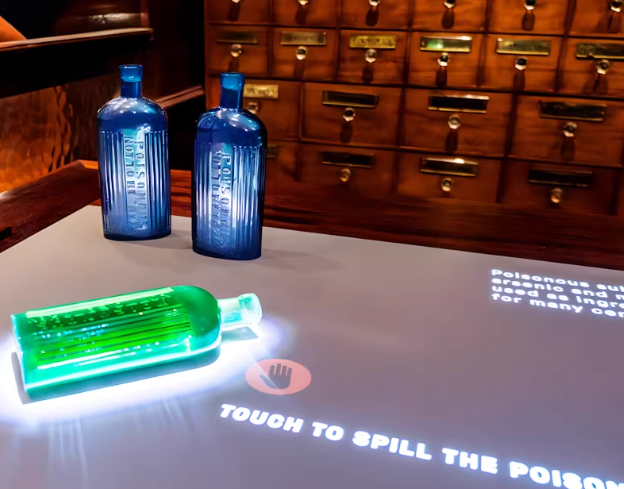
3. Common Application Scenarios
3.1 Museums, Science Centers & Exhibition Halls
Applications include:
- Digital sand tables
- Interactive maps
- 3D artifact visualization
- Educational quizzes
- Gamified learning modules
These installations increase dwell time and encourage collaborative exploration.
3.2 Restaurants & Themed Dining
Common features:
- Interactive menu ordering
- Animated table effects (water ripples, fish, stars)
- Kids games during waiting time
- Loyalty engagement programs
Benefits:
- Improved guest experience
- Reduced perceived wait time
- Higher upsell opportunities
3.3 Retail, Shopping Malls & Brand Activations
- Product catalogs
- Spin-to-win games
- Interactive brand storytelling
- Multiplayer competitions
Interactive tables attract foot traffic and increase brand recall.
3.4 Education & Children’s Spaces
- Alphabet & number learning
- Puzzle games
- Science simulations
- Cooperative classroom activities
In pediatric hospitals, interactive tables can reduce anxiety and create calming distraction environments.
4. Technical Architecture Types
4.1 Vision / LiDAR Capture System (Retrofit-Friendly)
Structure:
- Ceiling-mounted LiDAR or IR camera
- Projector mounted above table
- Standard table surface
Advantages:
- Works with existing furniture
- Supports irregular or custom table shapes
- Lower hardware cost
- Flexible scaling
This is ideal for:
- Exhibition retrofits
- Restaurant upgrades
- Temporary brand installations
4.2 Embedded Capacitive All-in-One Table
Structure:
- Large built-in capacitive touchscreen
- Integrated LCD display
Advantages:
- High precision
- Strong anti-interference
- Stable commercial operation
Disadvantages:
- Higher cost
- Fixed size and shape
- Heavy installation requirements
Best suited for:
- Permanent commercial spaces
- High-end digital showrooms
5. Why PoE LiDAR Is a Scalable Commercial Solution
Modern deployments increasingly favor PoE LiDAR-based interaction systems because:
- Single Ethernet cable = power + data
- Easier installation & maintenance
- Centralized network management
- High multi-touch accuracy
- Low latency (<20ms possible with optimized systems)
For integrators and OEM partners, this significantly reduces system complexity and installation time.
6. Procurement Checklist (For System Integrators & Buyers)
Before selecting a supplier, evaluate:
- Touch accuracy (mm-level precision?)
- Maximum simultaneous touch points
- Latency (target < 30ms)
- Ambient light tolerance
- SDK/API availability
- CMS support
- Custom content development support
- OEM/ODM flexibility
- After-sales technical support
- Global certification (CE, FCC, RoHS)
FAQ – Desktop Interactive Projection Tables
Q1: Is LiDAR better than infrared camera sensing?
LiDAR offers superior spatial depth accuracy and environmental adaptability, especially in bright environments. IR is cost-effective but more sensitive to lighting interference.
Q2: Can multiple people use the table simultaneously?
Yes. Advanced systems support 10+ simultaneous touch points and multi-user detection.
Q3: Does it require a special table surface?
No. LiDAR/vision-based systems can work on most matte surfaces. However, anti-glare materials are recommended.
Q4: What is the lifespan of such systems?
Commercial-grade systems typically operate 8–12 hours daily for 3–5+ years depending on projector maintenance.
Q5: Can it integrate with ordering systems or CRM platforms?
Yes. Most professional systems support API integration and backend connectivity.
Q6: Is it suitable for outdoor use?
Generally designed for indoor environments. Outdoor deployment requires brightness and weatherproof customization.
About CPJROBOT
CPJROBOT is a professional PoE LiDAR sensor and service robot manufacturer, specializing in:
- PoE LiDAR sensing modules
- Interactive projection solutions
- Greeting robots
- Commercial automation systems
We provide:
- OEM / ODM customization
- SDK integration support
- Global distributor partnership programs
- Technical training and project consultation
Our LiDAR-based interactive systems are designed for integrators, exhibition companies, restaurant groups, and smart retail solution providers worldwide.