
The technologies solve different sensing problems
“Infrared” and “camera” are broad categories, not single products. A fair comparison separates at least four approaches:
- LiDAR: measures distance from emitted and returned light.
- Infrared touch frame or beam grid: detects an interruption across a defined plane.
- RGB camera: captures color images that computer-vision software interprets.
- Depth camera: estimates per-pixel or per-point distance using stereo, structured light, time of flight, or another method.
Some depth cameras also use infrared light. Therefore, “LiDAR vs infrared vs camera” is a convenient buyer’s phrase, but the actual engineering comparison must use specific device architectures and test conditions.
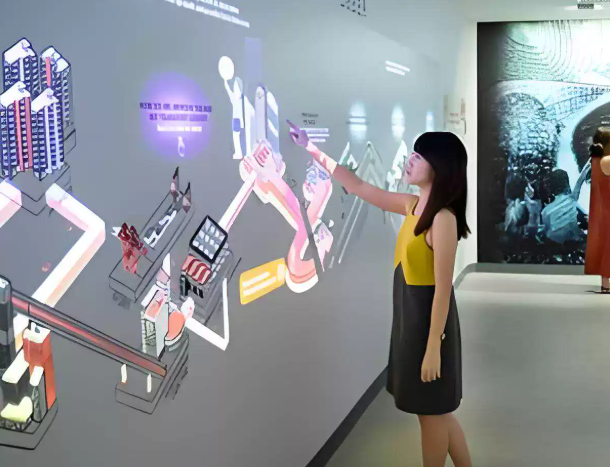
Side-by-side comparison
| Decision factor | LiDAR | Infrared touch frame / grid | RGB camera | Depth camera |
|---|---|---|---|---|
| Typical input | Range points, plane or zone events | Beam interruption near a surface | Images interpreted by vision software | Depth map or point data |
| Strong fit | Spatial zones, large surfaces, geometry-based detection | Defined rectangular touch-like surfaces | Gestures, silhouettes, visual tracking | Body/hand separation and 3D interaction |
| Lighting sensitivity | Device- and wavelength-dependent; strong external light can matter | Device- and installation-dependent; sunlight may interfere with some systems | Often strongly affected by illumination and background | Depends on sensing method; active IR systems can face interference |
| Color/background dependence | Generally low | Low | Often significant | Usually lower than RGB alone |
| Privacy profile | No conventional color image, but spatial data still needs governance | Minimal scene information | May capture identifiable imagery | Usually no color required, though some devices include RGB |
| Mechanical constraint | Clear field of view and stable mounting | Frame or emitters/receivers around active area | Clear camera view | Clear view and supported depth range |
| Main integration task | Spatial filtering and calibration | Frame alignment and touch mapping | Vision model/rules and scene tuning | Depth filtering, tracking, and calibration |
The table describes common tendencies, not guaranteed performance. Specifications and results vary by product, range, target, environment, and software.
Advantages and trade-offs
LiDAR
LiDAR can work from geometric distance data and may cover interaction zones without capturing color video. It can be attractive for large surfaces or defined planes. Trade-offs may include sparse measurements compared with image sensors, occlusion, reflectivity effects, scan geometry, and the need for careful spatial filtering.
Infrared touch frames
Infrared frames can provide direct screen-like interaction on a known rectangular boundary. They may be relatively easy for applications expecting touch coordinates. Frames or optics must remain aligned and unobstructed, and unusual shapes or open spatial gestures may not suit this architecture.
RGB cameras
RGB cameras provide visually rich information and flexible creative possibilities. Software can identify color, pose, shape, or gesture when the scene supports it. The same richness increases dependence on lighting, background, processing, and privacy controls.
Depth cameras
Depth cameras offer dense spatial information and can support skeleton, hand, or foreground separation. Their range, field of view, outdoor behavior, reflective-surface behavior, and multi-device interference vary by product and sensing method. For example, Intel documents that its RealSense D400 series uses stereo vision, with some models using an infrared projector to improve depth estimation.
Recommendations by scenario
Large interactive wall
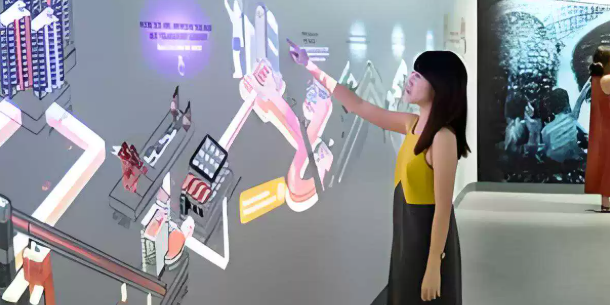
Consider LiDAR when a stable geometric interaction plane and non-video sensing are priorities. Consider an infrared frame for a defined rectangular, touch-like interface. Consider depth or RGB cameras when mid-air body or gesture interpretation is central.
Interactive floor
LiDAR or depth sensing can support spatial zones and movement. Camera vision can create silhouette-rich effects. The decision should be tested against ceiling height, crowd occlusion, shadows, lighting, and the required active area.
Retail gesture experience
If the concept depends on pose, visual object recognition, or rich gestures, a camera-based system may offer the necessary input. If the action is simply entering a region or approaching a surface, a less data-rich sensor may reduce complexity.
Bright or outdoor environment
Do not select by technology label. Obtain the device’s environmental specifications and run a test at the actual time of day. Direct sunlight and weather protection can affect active optical sensors as well as image visibility from the projector.
Privacy-sensitive location
Prefer the minimum data needed for the experience. LiDAR, beam grids, or depth-only processing may reduce collection of identifiable images, but privacy still requires documented data flow, access control, retention policy, and appropriate notices.
Cost, stability, and maintenance
Compare total installed cost, not only sensor price. Include mounting, cabling, processing hardware, software licenses, calibration time, custom development, content, commissioning, staff training, remote diagnostics, cleaning, spares, and expected downtime.
Stability is also system-specific. A simpler sensing principle can still fail if mounted poorly; sophisticated software can be reliable when the environment is controlled and validation is thorough. Ask vendors for a reproducible test, diagnostic tools, supported versions, and a recovery plan.
A five-step selection method for procurement teams
- Define the visitor action and measurable outcome.
- Document the site and operational constraints.
- Shortlist technologies that can produce the required input.
- Test them with representative content and users.
- Contract against measurable acceptance criteria and support responsibilities.
Avoid specifications that cannot be tested. “Accurate” should become an allowable error at defined locations. “Low latency” should become an end-to-end response target. “Multi-user” should state how many users, in what area, performing which actions.
Frequently asked questions
Is LiDAR more accurate than a camera?
That question is incomplete. Accuracy must specify the device, range, target, lighting, mounting, algorithm, and whether it means raw ranging accuracy or final interaction accuracy.
Is infrared the cheapest option?
Sometimes for a simple defined touch surface, but total cost depends on size, frame construction, installation, software, and maintenance. Compare complete configurations.
Which option needs the least maintenance?
The one designed for its environment with stable mounting, accessible cleaning, diagnostics, documented calibration, and available support. Technology type alone does not determine maintenance effort.