
Children’s public spaces—ranging from science centers and shopping mall family zones to interactive edutainment parks—are undergoing a massive paradigm shift. Traditional static exhibit panels and passive video displays are rapidly giving way to real-time, responsive multi-touch spaces like “Digital Forests,” “Interactive Oceans,” and dynamic ball-pit projection walls.
However, delivering zero-latency, high-concurrency touch experiences for children presents unique engineering hurdles. Traditional optical sensors and camera-based vision systems often suffer from light interference, high latency, limited multi-point support, and cumbersome calibration.
In this article, Shanghai CPJRobot Co., Ltd.—the manufacturer behind the specialized POELIDAR series—explores how purpose-built Time-of-Flight (TOF) interactive Lidar technology solves these core industry pain points, driving engagement and extending dwell times across commercial and educational venues.
The Paradigm Shift: Why Children’s Spaces Require Advanced Touch Sensing
Today’s “digital native” children expect immediate, physical feedback from their environment. When a child touches a projected tree on a wall, they expect leaves to bloom instantly; when a ball strikes an interactive ocean wall, the splash effect must trigger without visible delay.
Achieving this level of immersion requires overcoming four critical technical challenges:
- High-Frequency & Rapid Motion: Children move unpredictably—swiping, throwing balls, and running across interactive floors or walls. Slow sensing systems cause lag, breaking the immersion.
- Dense Multi-User Concurrency: Dozens of children frequently interact with the same wall or floor simultaneously. Standard touch frames or camera vision systems quickly drop touch points under high concurrency.
- Complex Ambient Lighting: Projectors, high-lumen spotlights, and ambient daylight create visual noise that degrades traditional camera or IR overlay performance.
- Hardware Protection & Aesthetics: Equipment must be installed out of children’s reach to prevent damage, while remaining discrete to preserve spatial design.
Rethinking Interactive Sensing: Traditional Lidar vs. Purpose-Built POELIDAR
For years, AV system integrators were forced to use industrial or automotive Lidars for interactive applications. These legacy devices created widespread industry frustration: complex debugging, short operational lifespan, unstandardized software protocols, and poor touch accuracy.
To solve these pain points, Shanghai CPJRobot Co., Ltd. engineered POELIDAR—a Lidar sensor suite designed specifically for the interactive exhibition and display industry.
+-----------------------------------------------------------------------------------+
|                            POELIDAR SYSTEM ARCHITECTURE                           |
|                                                                                   |
|  [ POELIDAR Sensor ] --(Cat6 POE Cable >100m)--> [ Gigabit POE Switch / PC ]      |
|         |                                                       |                 |
|         v                                                       v                 |
|  TOF Laser Scanning                                    Multi-Touch Engine         |
|  (270°-360°, 10-30 FPS)                                (TUIO / Windows Multi)     |
|         |                                                       |                 |
|         +-----------------------> [ Interactive Software ] <----+                 |
|                                   (Unity / Unreal / C++)                          |
+-----------------------------------------------------------------------------------+
Technical Comparison Matrix
| Parameter / Feature | Traditional IR / Camera Vision PDF+ 1 | POELIDAR-F1 (Pro Series) PDF | POELIDAR-M1 (Portable Series) PDF |
| Ranging Technology | Optical Tracking / IR Reflection | TOF (Time of Flight) Laser | TOF (Time of Flight) Laser |
| Scanning Angle | Narrow / Angle-Restricted | 270° Wide Angle | 360° Full Coverage |
| Practical Radius | Limited coverage | >11m Wall / >13m Ground | >4m Practical (12m Max) |
| Touch Accuracy | Lower accuracy, prone to drift | <2cm (6m wall) / <3cm (10m wall) | <3cm (4m wall) |
| Refresh Frame Rate | 10–15 FPS typical | Up to 30 FPS Real-Time | 10 FPS |
| Concurrency Points | Restricted multi-point | 256 Points (Win) / Unlimited (TUIO) | 256 Points (Win) / Unlimited (TUIO) |
| Power & Data Interface | Separate power/data runs | Single CAT6 Cable (IEEE 802.3af POE) | Single CAT6 Cable (IEEE 802.3af POE) |
| Multi-Device Cascade | Difficult to sync | >20 Lidars Cascaded on 1 PC | >20 Lidars Cascaded on 1 PC |
Real-World Applications in Children’s Interactive Spaces
1. Immersive “Digital Forest” & “Ocean Discovery” Walls
- Scenario: Projected continuous wall surfaces where children touch flora and fauna to trigger animations and soundscapes.
- POELIDAR Solution: Utilizing the POELIDAR-F1 with a 270° scanning sweep and 30 FPS frame rate, the system tracks simultaneous hand touches across walls exceeding 20 meters. The <2cm touch accuracy ensures even small children’s hands trigger exact coordinates without lag.
2. High-Impact Interactive Ball-Pit Walls
- Scenario: Children toss physical balls at wall projections to hit moving targets.
- POELIDAR Solution: Fast-moving objects require instantaneous coordinate registration. With TUIO protocol support and high-density point clouds, POELIDAR registers rapid physical impacts across multiple hit-zones concurrently without missing detection points.
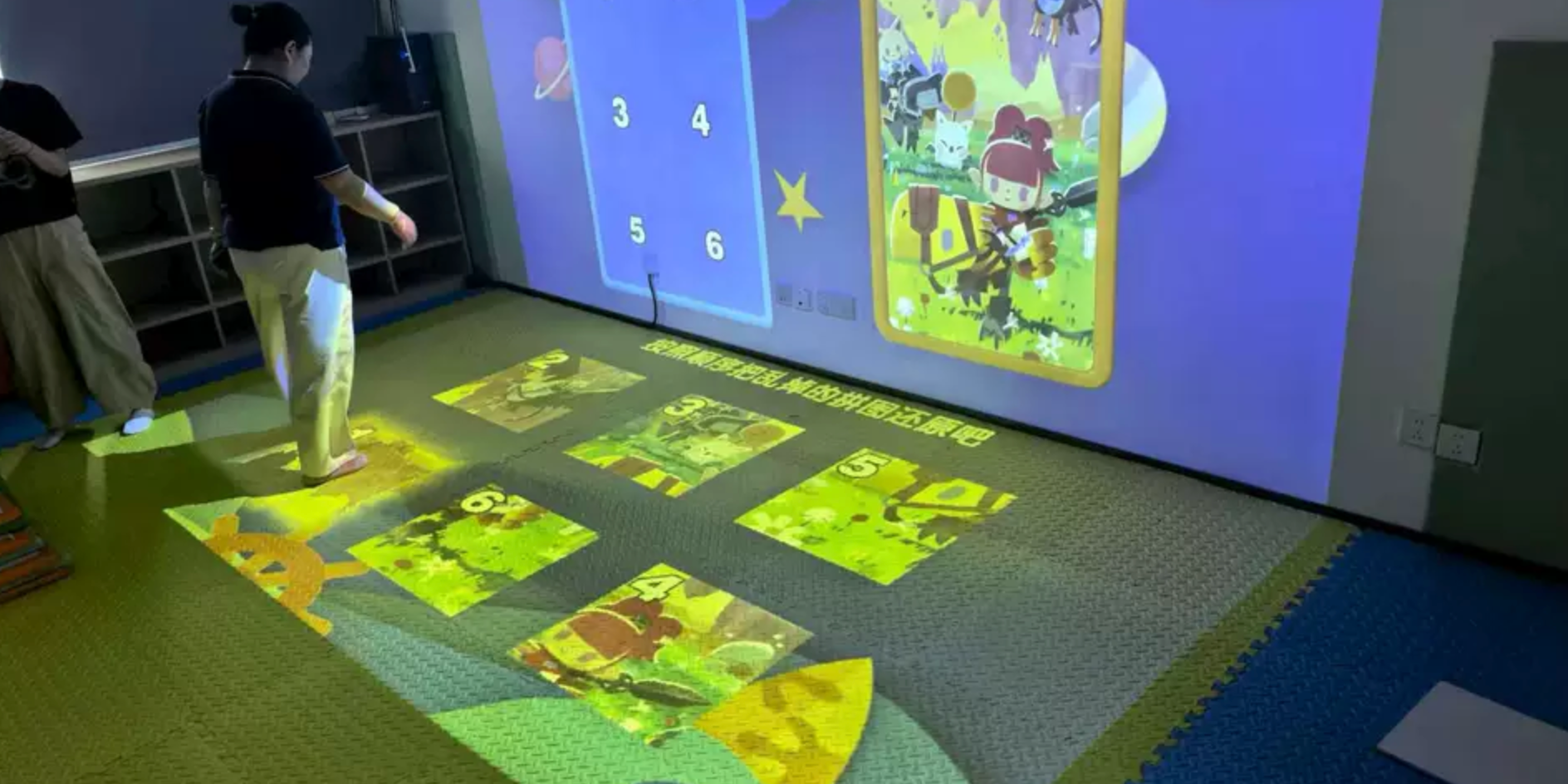
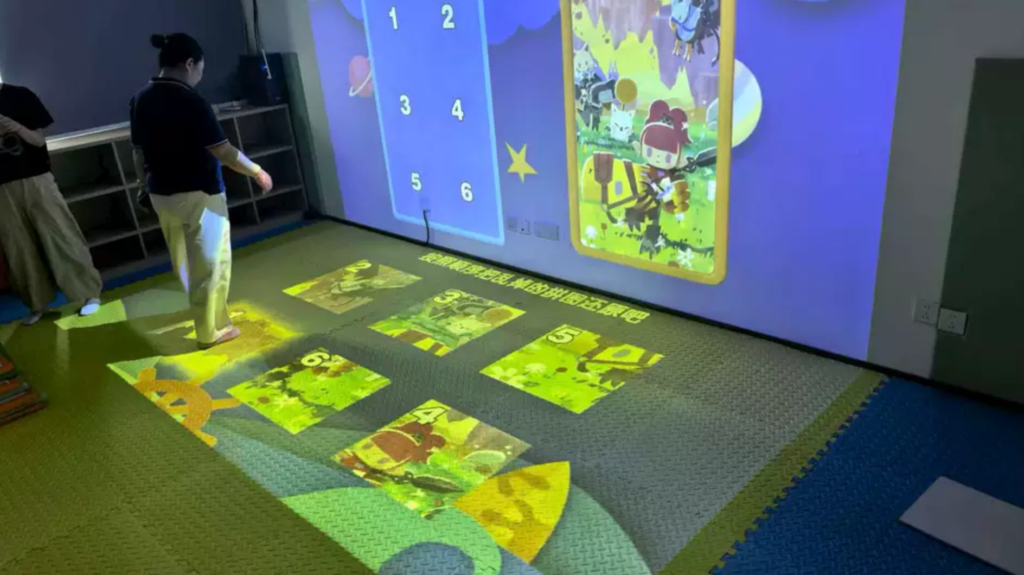
3. Interactive Floor Projection & Stepping Games
- Scenario: Floor-projected streams, lily pads, or piano keys that respond to jumping children.
- POELIDAR Solution: Mounted subtly at floor level, POELIDAR-M1 or F1 scans flat, L-shaped, curved, or multi-folded ground surfaces. Its IP65 waterproof and dustproof construction (F1 model) ensures resilience against dust and accidental liquid spills.
+-----------------------------------------------------------------------------------+
|                         POELIDAR INTERACTIVE SCENARIOS                            |
|                                                                                   |
|    [ Wall Projection ]          [ Interactive Floor ]       [ Curved / L-Shaped ] |
|   +-------------------+        +---------------------+      +-----------------+   |
|   |  *  Digital     * |        |  *  Stepping Game * |      |  *  Immersive * |   |
|   |  *  Forest      * |        |  *  Interactive   * |      |  *  Arc Wall    * |   |
|   +-------------------+        +---------------------+      +-----------------+   |
|          ^                            ^                            ^              |
|          |                            |                            |              |
|   POELIDAR Surface Scan        POELIDAR Floor Sweep         Multi-Lidar Cascade   |
+-----------------------------------------------------------------------------------+
Engineering & Integration Benefits for Systems Integrators
Beyond user experience, CPJRobot engineered POELIDAR to simplify deployment for AV contractors and software developers:
- Single-Cable POE Deployment: Power and data transmit over a standard CAT6 Ethernet cable up to 100+ meters using the IEEE 802.3af POE standard, eliminating the need for local power outlets near the radar.
- Universal Software Compatibility: Out-of-the-box integration with major interactive engines, including Unity, Unreal Engine, C#, C++, Processing, and TouchDesigner via TUIO and Windows native multi-touch protocols.
- Multi-Radar Cascading: Complex spaces with corners, pillars, or massive square footage can network over 20 POELIDAR units into a single computer system.
- Automated Operational Maintenance: Software auxiliary features include program playlist looping and auto power-down synchronized with the host computer system.
Conclusion
Transforming children’s environments from static exhibit boards into dynamic “digital forests” requires sensing hardware built specifically for high-concurrency, low-latency, and harsh physical environments. By replacing legacy industrial Lidars with purpose-built interactive TOF sensors, venue operators and integrators can deliver seamless, high-dwell-time experiences with long-term reliability.