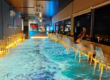

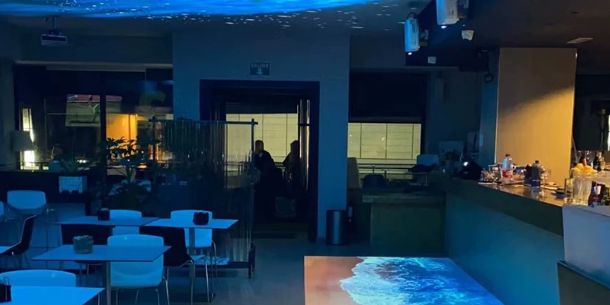
In today’s nightlife industry, creating a memorable atmosphere requires more than music, lighting, and interior design. Bars and nightclubs increasingly explore immersive technologies that encourage guests to interact with their surroundings.
One creative solution is the interactive bar floor, where ordinary flooring transforms into a dynamic ocean filled with animated waves, glowing particles, and responsive visual effects.
Imagine guests walking into a nightclub and seeing digital waves spread beneath their feet. As more people join, the entire floor becomes a collaborative visual experience.
By combining CPJROBOT PoE LiDAR with interactive projection software, venue designers can create responsive environments that enhance visual atmosphere and encourage guests to capture and share memorable moments.
This guide explores the applications, technical architecture, multi-user tracking, and planning considerations for wave interactive floors in bars and nightclubs.
1. What Is an Interactive Wave Floor?
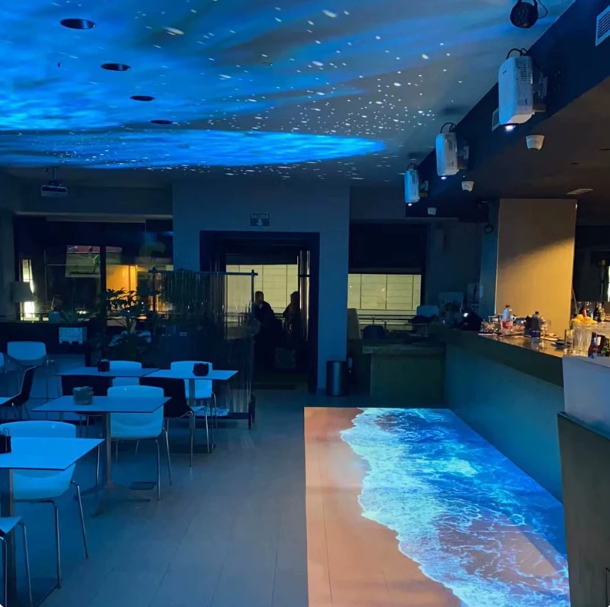
An interactive wave floor is a projection-based installation that responds to visitors’ movements.
Unlike conventional LED floors or prerecorded projection animations, a LiDAR-based interactive floor uses position detection to control visual effects in real time.
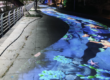
For example, when a guest steps onto the floor, animated water ripples expand around the detected position. When several guests move together, their interactions generate overlapping waves.
Possible effects include:
- Ocean waves responding to footsteps
- Glowing water ripples and particle trails
- Virtual fish swimming around visitors
- Color-changing waves synchronized with music
- Interactive light patterns generated by multiple guests
A typical system combines projectors, CPJROBOT PoE LiDAR sensors, tracking software, and a real-time visual engine such as TouchDesigner.
The result is an immersive floor experience where guest movement becomes part of the venue’s visual atmosphere.
2. How Interactive Floors Enhance Bar and Nightclub Atmosphere
Nightlife venues compete to create distinctive experiences that visitors associate with their brands.
Traditional lighting and decorative installations are primarily visual. An interactive bar floor introduces another dimension: participation.
Turning Passive Spaces into Interactive Environments
A conventional projection displays the same animation regardless of guest behavior.
An interactive floor changes according to movement.
For example, a lounge area can display calm ocean waves during quieter periods.
As guests enter the space, animated ripples appear beneath their feet, creating a subtle response without disrupting conversation.
Later in the evening, the same installation can display brighter effects synchronized with the music.
This flexibility allows venues to adapt the atmosphere throughout the night.
Encouraging Guests to Explore
Interactive floors introduce an element of discovery.
Guests may notice the projected waves, step onto the illuminated surface, and experiment with different movements.
This creates opportunities for playful interaction and social engagement.
A distinctive experience may also encourage guests to explore the venue for longer. However, any increase in dwell time should be measured rather than assumed.
Creating a Recognizable Venue Identity
Instead of relying entirely on standard decorative lighting, bars can develop customized visual themes.
Examples include tropical ocean waves, futuristic neon water, digital waterfalls, and branded particle effects.
These themes can reinforce a venue’s design concept while creating visual differentiation.
3. Creating Shareable Moments for Social Media
One of the strongest creative opportunities for nightclub projection is its suitability for short-form video content.
Interactive wave effects create natural movement, making them visually engaging when recorded on smartphones.
Imagine a guest stepping onto a glowing ocean floor while animated waves spread around their shoes.
Friends can capture the interaction from different angles, producing short videos that showcase the venue’s atmosphere.
Why Interactive Projection Works for Short Videos
Immediate Visual Response
Footstep-triggered waves create a clear connection between human movement and digital animation.
Dynamic Lighting Effects
Glowing water patterns and moving particles create visually distinctive scenes.
Group Participation
Several guests can interact together, creating moments suitable for group videos.
Customizable Brand Elements
Venues can integrate recognizable colors, visual themes, or brand-related animations into the experience.
Designing for Video-Friendly Interaction
For bar owners and experience designers, the installation should be planned with filming conditions in mind.
Important considerations include:
- Clear visibility of wave effects around visitors
- Suitable projection contrast under venue lighting
- Attractive viewing angles for smartphone recording
- Enough space for participants and spectators
- Visual effects that remain recognizable in short clips
The objective is to create an experience that guests genuinely enjoy and may choose to share.
User-generated content can extend a venue’s visibility beyond its physical location, although actual reach and engagement depend on audience behavior and the content itself.
4. How CPJROBOT PoE LiDAR Powers Interactive Bar Floors
The sensing system is central to an interactive floor installation.
CPJROBOT PoE LiDAR uses laser-based distance measurement to detect objects intersecting a configured scanning plane.
With suitable mounting and tracking software, the detected positions can be mapped to projected floor content.
System Architecture
A typical installation follows this workflow:
Guest Movement → CPJROBOT PoE LiDAR → Coordinate Processing → Interactive Software → Wave Animation → Floor Projection
First, LiDAR detects activity within the interaction area.
Processing software converts sensor measurements into coordinates.
The coordinates are then delivered to a compatible visual engine, which generates effects such as water ripples, glowing footprints, or particle movement.
Why PoE Connectivity Matters
CPJROBOT PoE LiDAR models use Ethernet connectivity with Power over Ethernet support.
This provides practical advantages for commercial installations.
Simplified Cabling
Compatible PoE connections supply power and network connectivity through a single Ethernet cable.
Flexible Sensor Placement
Sensors can be installed around designated interaction zones according to scanning range and mounting requirements.
Centralized Infrastructure
Multiple compatible sensors can connect through appropriately rated PoE network switches.
System Expansion
Additional detection zones can be introduced when the project requires wider coverage.
For example, CPJROBOT offers the F1 PoE LiDAR with a 270° scanning field and the M1 PoE LiDAR with 360° scanning coverage.
The appropriate sensor should be selected according to installation dimensions, mounting geometry, and tracking requirements.
5. Multi-User Interaction: Making the Entire Floor Come Alive
A nightclub floor may contain many visitors moving simultaneously.
Unlike single-user interactive displays, a nightclub projection system must respond to multiple participants while maintaining stable visual behavior.
Multi-Point Tracking
With suitable processing software, LiDAR detections can be converted into multiple interaction coordinates.
Each coordinate can control an independent visual effect.
For example:
- Guest A generates blue water ripples.
- Guest B activates glowing particles.
- Guest C creates a moving wave trail.
- A group of guests produces overlapping ocean effects.
The interaction becomes a shared experience rather than a single-player activity.
Managing High Visitor Density
Crowded environments introduce additional technical challenges.
Visitors may stand close together, cross paths, or partially block a sensor’s scanning plane.
Tracking software must manage overlapping detections, temporary occlusion, and changing movement patterns.
Practical approaches include position filtering, cluster detection, detection-zone management, and multi-sensor fusion.
For wave projection, tracking every guest’s individual identity may not always be necessary.
An occupancy-based system can generate effects from detected movement regions, helping simplify crowded-floor interaction.
This approach is particularly useful when the primary objective is immersive atmosphere rather than precise individual footstep identification.
6. Multi-LiDAR Integration for Large Nightclub Floors
Small interactive areas may be supported by a limited number of sensors.
However, large nightclub floors, connected lounge zones, and entertainment venues may require a multi-LiDAR tracking system.
Expanding Detection Coverage
Multiple CPJROBOT PoE LiDAR sensors can be positioned around the intended interaction area.
Each sensor monitors a designated region according to its effective detection range and scanning geometry.
The sensors can connect to shared network infrastructure, while software combines their data into a unified interaction space.
This is often described as multi-LiDAR integration or sensor cascading.
Importantly, network connectivity alone does not automatically merge the sensors’ tracking data.
Coordinate Calibration
Each LiDAR measures positions relative to its own location.
To create consistent tracking across the entire floor, the software must transform these measurements into a shared coordinate system.
A typical calibration process includes:
- Defining the complete interactive floor area.
- Establishing sensor positions and orientations.
- Measuring reference points for coordinate alignment.
- Converting local coordinates into global coordinates.
- Managing overlapping detection zones.
- Testing movement across sensor boundaries.
Correct calibration helps ensure that projected waves appear near the intended interaction positions.
Avoiding Duplicate Detection
When multiple sensors cover overlapping areas, the same guest may be detected more than once.
Sensor-fusion software can compare position, timing, and movement history to associate detections.
This reduces duplicated visual triggers and supports more consistent interaction across larger spaces.
The number of LiDAR sensors required depends on floor dimensions, sensor range, obstacles, and expected visitor density.
7. Using TouchDesigner for Music-Synchronized Wave Effects
TouchDesigner provides a flexible development environment for combining LiDAR tracking with real-time graphics and audio analysis.
It can be used to create wave effects that respond to both visitor movement and nightclub music.
Connecting LiDAR Tracking Data
Processed position coordinates can be transmitted to TouchDesigner through compatible OSC/UDP communication.
Depending on the selected CPJROBOT sensor and software interface, SDK integration or middleware may be required.
TouchDesigner operators can then process the received data.
OSC In CHOP: Receives OSC-based numerical tracking data.
Math CHOP: Converts tracking coordinates into the projection area.
Filter CHOP: Smooths motion data.
Logic CHOP: Controls activation conditions.
Feedback TOP: Supports persistent wave and particle effects.
Combining Music and Movement
Interactive visuals can respond to both LiDAR coordinates and audio signals.
For example:
Music Bass: Controls wave intensity or ripple amplitude.
Guest Movement: Defines where water effects appear.
Music Tempo: Influences animation speed.
Group Interaction: Creates larger combined wave patterns.
GPU-Based Wave Rendering
Developers can use GLSL shaders and GPU-based rendering techniques to produce customized water simulations, ripples, and particle effects.
TouchDesigner’s geometry instancing features can also support repeated visual elements such as glowing particles.
By combining efficient rendering with suitable tracking filters, developers can design responsive visual effects without requiring a separate prerecorded animation for every interaction.
Performance should be validated using the actual workstation, projection resolution, and expected interaction load.
8. Key Planning Considerations for Nightclub Interactive Floors
Successful deployment requires careful coordination between visual design and the physical venue.
Ambient Lighting
Nightclubs contain moving lights, laser effects, LED displays, and rapidly changing illumination.
Although LiDAR does not depend on conventional visible-light image recognition, optical interference and installation conditions can still affect detection.
Projector visibility must also be evaluated separately from LiDAR tracking performance.
Floor Material
Relatively smooth, light-colored surfaces generally provide better projected image visibility than dark, highly textured floors.
Reflective or polished flooring may create glare.
Floor finishes should also meet applicable slip-resistance and venue safety requirements.
Installation Position
LiDAR sensors should be positioned to reduce obstruction, accidental contact, and equipment damage.
Mounting geometry must support the intended interaction plane.
Crowd Movement and Safety
Interactive wave effects should not encourage unsafe running, sudden movement, or congestion.
Projection equipment and sensor installations must not obstruct exits, walking routes, or emergency access.
Equipment Protection
Bars and nightclubs may expose equipment to spilled drinks, cleaning chemicals, vibration, and accidental impact.
Appropriate mounting, protective housings, cable management, and maintenance access are essential.
System Performance
The complete system should be tested for tracking stability, rendering performance, and input-to-display latency during realistic crowd conditions.
9. Measuring the Commercial Value of an Interactive Bar Floor
For venue operators, interactive projection is a customer-experience investment.
Its value should be evaluated through measurable outcomes rather than visual appeal alone.
Possible performance indicators include:
Guest Engagement: The number of guests interacting with the projection.
Interaction Duration: How long participants remain engaged with the floor.
Social Media Activity: The quantity of guest-created videos and posts featuring the installation.
Zone Dwell Time: Whether visitors spend more time in the interactive area.
Repeat Engagement: Whether guests return to interact again during the same visit.
Operating Reliability: System availability and maintenance requirements.
When practical, venues can compare these metrics before and after installation while accounting for differences in attendance, programming, and operating hours.
This helps determine whether the installation contributes to the venue’s commercial objectives.
10. Frequently Asked Questions
Can CPJROBOT PoE LiDAR work in dark nightclubs?
Yes, LiDAR-based detection does not require conventional visible-light image recognition. However, performance still depends on sensor specifications, reflective surfaces, optical interference, and installation geometry.
Can multiple guests interact with the wave floor simultaneously?
Yes. Multi-user interactions can be implemented using compatible CPJROBOT LiDAR sensors and tracking software. Actual capacity depends on system configuration and crowd conditions.
Can interactive waves synchronize with nightclub music?
Yes. TouchDesigner and other compatible visual engines can combine audio analysis with LiDAR tracking coordinates to generate music-responsive wave and particle effects.
How can large nightclub floors be covered?
Large areas can use multiple LiDAR sensors connected through suitable network infrastructure. Coordinate calibration and sensor-fusion software are required to combine detection zones.
Can existing bar floors be used for interactive projection?
Often, yes. However, the existing flooring must be assessed for projection visibility, surface reflectivity, pedestrian safety, and installation compatibility.
Does interactive floor projection increase customer dwell time?
Interactive installations may encourage exploration and engagement, but increased dwell time is not guaranteed. Venues should measure actual visitor behavior to evaluate the results.
Conclusion: Transform Nightlife with CPJROBOT Interactive Wave Projection
Interactive wave floors offer bars and nightclubs an opportunity to move beyond conventional lighting and decorative projection.
By transforming footsteps into animated waves, glowing particles, and music-responsive effects, venues can create immersive experiences that encourage participation and memorable social moments.
With CPJROBOT PoE LiDAR, developers can build sensing systems for interactive bar floors, multi-user nightclub projection, and larger installations using multiple calibrated sensors.
Combined with TouchDesigner and creative visual content, these systems can turn an ordinary floor into a dynamic part of the nightlife experience.
Ready to create an unforgettable interactive bar or nightclub floor?
Explore CPJROBOT PoE LiDAR solutions and contact our team to discuss interactive wave projection, multi-sensor tracking, and customized entertainment installations.