
Public parks are evolving beyond traditional green spaces into immersive destinations where technology, entertainment, and natural landscapes come together.
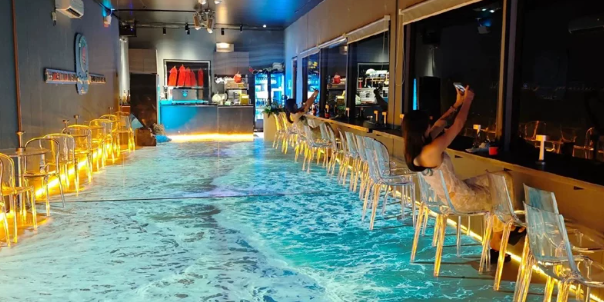
One increasingly attractive concept is ocean wave floor projection, which transforms ordinary walkways and plazas into animated coastal environments. As visitors walk across the projected surface, virtual waves ripple around their footsteps, glowing fish swim away, and digital water responds to movement.
Unlike conventional projection displays, interactive floor installations allow visitors to become active participants in the experience.
By combining CPJROBOT PoE LiDAR with outdoor projection systems, park designers and system integrators can create motion-responsive environments for nighttime tourism, family entertainment, and public art installations.
This guide explores the practical applications of wave floor projection in parks and the engineering considerations required for reliable outdoor operation.
1. What Is Ocean Wave Floor Projection?
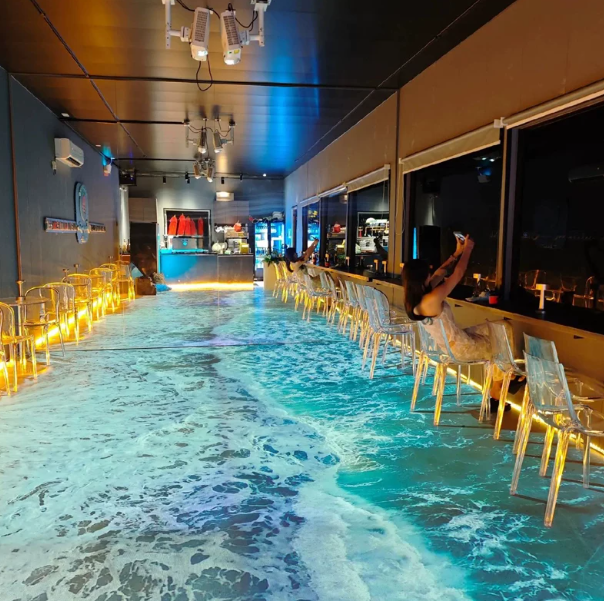
Ocean wave floor projection is an interactive visual installation that displays animated ocean environments onto physical ground surfaces.
These installations may include moving waves, simulated water reflections, marine creatures, and glowing underwater effects.
When combined with LiDAR-based tracking, the projected content can respond to visitors’ positions and movements.
For example:
- Walking across the projection generates animated water ripples.
- Virtual fish move away from approaching visitors.
- Footsteps create glowing wave patterns.
- Multiple participants influence the same digital ocean.
- Different activity zones trigger customized marine animations.
A typical interactive ocean floor projection system consists of LiDAR sensors, a processing workstation, interactive content software, projectors, and suitable outdoor infrastructure.
CPJROBOT PoE LiDAR provides the sensing component, detecting objects that intersect its configured scanning plane and enabling compatible software to generate interaction coordinates.
These coordinates can then control real-time ocean animations.
The result is a visually engaging installation that encourages natural interaction without requiring handheld controllers.
2. Three Applications of Wave Floor Projection in Public Parks
2.1 Nighttime Tourism and Immersive Park Walkways
Nighttime tourism has become an important consideration for parks, waterfront attractions, and cultural tourism destinations.
Interactive projection can introduce visually engaging experiences into existing pedestrian spaces without permanently changing the landscape.
Imagine a park walkway transformed into a flowing digital ocean.
As visitors move along the path, animated waves follow their footsteps. Different sections reveal glowing fish, coral reefs, or simulated underwater currents.
Unlike conventional decorative lighting, interactive projection responds to visitor behavior.
Potential applications include:
- Nighttime park walking routes
- Waterfront tourism attractions
- Cultural festival installations
- Illuminated garden experiences
- Seasonal nighttime events
For park operators, these installations can create additional reasons for visitors to explore specific areas after dark.
However, projection visibility, pedestrian safety, and operating schedules must be carefully planned.
2.2 Interactive Photo Spots and Social Media Attractions
Public parks increasingly incorporate recognizable visual features where visitors can take photographs and create short videos.
An interactive ocean floor can turn an ordinary plaza into a distinctive digital attraction.
For example, visitors could stand in a projected ocean surrounded by animated waves and colorful marine life.
As they move, the environment responds with expanding water patterns or glowing particle effects.
Designers can create different visual themes for festivals, promotional campaigns, and seasonal events.
Interactive photo installations work particularly well in:
- Scenic park entrances
- Waterfront observation areas
- Public squares
- Tourism landmarks
- Cultural event spaces
When planning these locations, designers should consider camera viewing angles, projection contrast, crowd circulation, and the visibility of effects from surrounding pedestrian areas.
2.3 Family Entertainment and Children’s Activity Zones
Interactive wave projection can also support family-oriented entertainment.
Instead of simply displaying an ocean animation, the installation becomes a digital playground where children can explore the environment through movement.
Possible interactive activities include:
Chasing Digital Fish: Virtual fish change direction when participants approach.
Wave Jumping: Stepping into designated areas generates animated water splashes.
Ocean Exploration: Different zones reveal marine creatures and educational information.
Collaborative Water Effects: Multiple visitors create overlapping waves and colorful patterns.
These activities can combine physical movement with interactive learning.
For children’s areas, however, visual effects should be designed to avoid encouraging unsafe running, crowding, or sudden directional changes.
The goal is to create an engaging experience while maintaining safe pedestrian movement.
3. How CPJROBOT PoE LiDAR Supports Interactive Ocean Projection
The sensing system is one of the most important components of an interactive floor installation.
For outdoor parks, sensors must detect visitor activity despite changing environmental conditions and variable traffic levels.
CPJROBOT PoE LiDAR offers Ethernet connectivity and Power over Ethernet support, making compatible models suitable for integration into network-based interactive systems.
How the System Works
A typical installation follows this process:
Visitor Movement → PoE LiDAR Detection → Coordinate Processing → Interactive Software → Ocean Animation → Floor Projection
First, LiDAR detects objects intersecting the scanning plane within the configured area.
Processing software converts the measurements into usable tracking coordinates.
These coordinates are transmitted to an interactive visual engine, such as TouchDesigner or another compatible application.
The software then generates water ripples, animated waves, or marine creature movements according to the programmed interaction rules.
Benefits of LiDAR-Based Detection
Less Dependence on Visible Lighting
LiDAR measures distance using laser-based sensing rather than conventional visible-light image recognition.
This can make it more consistent than some camera-based tracking arrangements under changing visible lighting conditions.
Natural Interaction
Visitors can interact through walking and movement without carrying devices.
Multi-Point Interaction
With suitable tracking software, multiple interaction positions can be processed simultaneously.
Flexible Installation
Multiple sensors can be arranged to support different detection zones, subject to scanning geometry and coverage requirements.
Network-Based Integration
PoE connectivity can simplify compatible power and Ethernet cabling arrangements.
Outdoor use still requires appropriate environmental protection, and the selected LiDAR model must be evaluated for the site’s conditions.
4. Ambient Light: Can Ocean Wave Projection Work in Outdoor Parks?
One of the biggest challenges for outdoor interactive projection is ambient light.
Public parks may contain streetlights, decorative lighting, nearby buildings, and illuminated pathways.
These light sources affect the visibility of projected graphics.
Projector Brightness vs. LiDAR Detection
It is important to distinguish between two separate functions.
Projector visibility depends on environmental light, projected image brightness, ground reflectivity, and contrast.
LiDAR detection depends on laser ranging performance, target characteristics, sensor geometry, and environmental interference.
Although LiDAR does not require visible-light image recognition, strong sunlight and other sources of optical interference may still affect certain sensors.
Therefore, a LiDAR tracking system may continue detecting movement when projected images are difficult to see.
This distinction is essential when planning outdoor installations.
Planning Around Park Lighting Schedules
For wave floor projection, designers should evaluate the actual lighting conditions during operating hours.
Important factors include:
- Sunset and twilight conditions
- Streetlight switching schedules
- Nearby decorative lighting
- Seasonal changes in daylight
- Reflections from surrounding surfaces
- Required visual contrast
Where possible, the projection area should be tested during its intended operating period.
Projector brightness should be selected based on the illuminated area, ground material, ambient light levels, and required image quality.
A single lumen specification cannot accurately determine performance for every outdoor park.
5. Choosing the Right Ground Surface for Wave Floor Projection
Ground material directly influences how projected ocean graphics appear.
Different surfaces have different reflectivity, texture, and visual characteristics.
Light-Colored Concrete
Relatively smooth, light-colored concrete can provide a suitable projection surface because it generally reflects more visible light than dark pavement.
However, cracks, uneven surfaces, and existing markings may affect image uniformity.
Stone and Paved Walkways
Stone surfaces are common in public parks.
Their suitability depends on color, texture, and surface finish.
Highly polished materials may create unwanted reflections, while rough surfaces can reduce image sharpness.
Asphalt and Dark Pavement
Dark ground surfaces typically absorb more projected light.
This can reduce image visibility and may require greater projector output or a smaller illuminated area.
Wet or Reflective Surfaces
Water can significantly change surface reflectivity and create glare.
Since wave projection may visually resemble water, designers must ensure the installation does not obscure real hazards, puddles, steps, or changes in ground level.
Engineering Recommendation: Test projection contrast on the actual ground material before finalizing projector specifications.
Surface safety and drainage should take priority over visual appearance.
6. How to Plan the Size of an Outdoor Interactive Projection Area
The physical dimensions of an interactive installation affect projector selection, LiDAR coverage, and overall system complexity.
Small Interactive Zones
Suitable for park entrances, compact photo spots, and dedicated children’s activity areas.
These installations may require fewer sensors and a simpler tracking configuration.
Medium-Sized Interactive Areas
Suitable for plazas, family entertainment zones, and thematic walking spaces.
Larger dimensions may require multiple projection zones and additional tracking coverage.
Large-Scale Interactive Installations
Large walkways or plazas may require multiple projectors and LiDAR sensors.
Projector blending, coordinate alignment, sensor placement, and tracking consistency become increasingly important.
Multi-LiDAR Coverage Planning
Each LiDAR sensor detects activity within its specified scanning field and effective range.
When multiple devices are used, tracking coordinates must be calibrated to a shared coordinate system.
Overlapping detection zones may also require software processing to prevent the same visitor from being counted multiple times.
The number of sensors should be determined through an engineering assessment rather than floor area alone.
7. Managing Visitor Density and Multi-User Interaction
Public parks experience fluctuating visitor numbers.
A projection installation may serve only a few visitors during quiet hours but attract significantly larger groups during weekends or festivals.
For this reason, designers should evaluate crowd density before choosing the tracking architecture.
Multiple Simultaneous Participants
A multi-user system needs to detect and process several interaction points without confusing nearby visitors.
The available tracking capacity depends on sensor specifications, software algorithms, and installation geometry.
Tracking Stability
As visitor density increases, occlusion and overlapping detections may become more common.
Proper sensor positioning, data filtering, and multi-sensor fusion can help improve tracking continuity.
Interaction Design for Crowded Environments
Not every installation requires individual tracking identities.
For example, an ocean wave effect may respond to occupied zones rather than tracking every visitor separately.
This can simplify the interaction logic and help manage visual complexity.
In high-traffic public areas, intuitive group-based interaction may be more practical than games requiring precise individual foot tracking.
8. Outdoor Installation and Maintenance Considerations
Reliable outdoor interactive projection requires more than selecting projectors and LiDAR sensors.
Environmental protection, cable management, and maintenance access are also essential.
Weather Protection
Outdoor equipment may be exposed to rain, dust, humidity, wind, and temperature changes.
Select protective enclosures according to the equipment’s verified environmental ratings and installation requirements.
Do not assume that PoE connectivity makes a LiDAR sensor waterproof or suitable for unprotected outdoor mounting.
Sensor Positioning
LiDAR sensors should be positioned to reduce accidental obstruction and physical damage.
Protective windows or covers must not interfere with the sensor’s optical scanning performance.
Electrical and Network Safety
Outdoor electrical infrastructure should incorporate appropriate grounding, weather-resistant connections, circuit protection, and applicable local electrical safety requirements.
Long-Term Maintenance
Routine maintenance should include:
- Cleaning projector and sensor optical surfaces
- Checking cable connections and enclosures
- Inspecting mounting stability
- Verifying coordinate calibration
- Testing interaction accuracy
- Checking drainage and ground conditions
A maintenance plan is especially important for permanent public park installations.
9. Frequently Asked Questions
Outdoor parks have strong ambient light. Does LiDAR still work?
LiDAR uses laser-based distance measurement rather than conventional visible-light image recognition, making it less dependent on visible lighting conditions than some camera-based solutions. However, direct sunlight, surface reflectivity, and environmental interference can still affect performance. Outdoor suitability should be verified for the specific sensor and installation.
Can wave floor projection operate during daylight?
Daylight significantly reduces the visibility of most conventional floor projections. Interactive wave installations are generally better suited to nighttime or controlled low-light environments. LiDAR detection and image visibility must be evaluated separately.
Can CPJROBOT PoE LiDAR detect multiple visitors?
Multi-point detection is possible with compatible CPJROBOT LiDAR solutions and tracking software. Actual performance depends on the sensor configuration, detection geometry, and crowd density.
How many projectors and LiDAR sensors are needed?
Equipment quantity depends on projection dimensions, ambient lighting, required image brightness, tracking coverage, and installation geometry. A site survey is recommended before final equipment selection.
Is CPJROBOT PoE LiDAR waterproof?
PoE refers to power and network connectivity, not waterproof protection. Outdoor deployment requires verifying the selected model’s environmental specifications and providing suitable protection where necessary.
Can interactive ocean effects be customized?
Yes. With compatible interactive software, developers can customize wave patterns, marine animations, particle effects, interaction zones, and multi-user behavior according to project requirements.
Conclusion: Creating Interactive Ocean Experiences in Public Parks
Ocean wave floor projection offers a creative way to transform public parks into immersive nighttime destinations.
From interactive walking routes and digital photo spots to family entertainment areas, these installations combine visual storytelling with natural human movement.
However, successful outdoor deployment requires careful planning.
Ambient lighting, ground materials, projection dimensions, visitor density, sensor positioning, and environmental protection all influence system performance.
By integrating CPJROBOT PoE LiDAR with an appropriately engineered projection system, developers can create responsive ocean-themed environments for public parks, tourism attractions, and outdoor entertainment spaces.
Planning an outdoor interactive floor projection project?
Explore CPJROBOT PoE LiDAR solutions and contact our team to discuss sensor integration, interactive floor tracking, and customized projection applications.