

Running an indoor playground is becoming increasingly competitive. Traditional soft play centers, ball pits, climbing structures, and plastic slides remain popular with younger children, but many venues struggle to maintain excitement as customers grow older or visit repeatedly.
For playground owners, completely replacing existing equipment is rarely an easy decision. New installations can require significant investment, construction downtime, and changes to the original floor plan.
But what if an ordinary slide could become an underwater adventure? What if a ball pit wall could turn into a digital target game? What if an empty floor could become an interactive ocean filled with moving fish?
Interactive projection offers a practical way to modernize existing indoor playgrounds without completely rebuilding their physical attractions.
By combining projectors, interactive software, and CPJROBOT PoE LiDAR sensors, operators can introduce digital games and motion-responsive experiences into existing play spaces.
The result is a hybrid playground that combines physical activities with digital entertainment, allowing operators to refresh their attractions while potentially reducing the construction work associated with conventional renovations.
1. Why Traditional Indoor Playgrounds Need an Upgrade
1.1 Similar Equipment Makes It Difficult to Stand Out
Many indoor playgrounds feature nearly identical attractions: colorful slides, ball pits, tunnels, climbing frames, and trampolines.
While these facilities remain useful, they may offer limited differentiation in competitive shopping malls or family entertainment destinations.
For parents deciding where to take their children, a playground that offers something visually distinctive and interactive may have a stronger marketing proposition.
1.2 Older Children Need More Engaging Experiences
Traditional soft play equipment is often designed around younger age groups.
As children grow, they may become more interested in challenges, competition, collaborative games, and technology-driven entertainment.
Interactive projection can introduce experiences such as:
- Digital target-hitting games and scoring competitions
- Team-based interactive wall activities
- Motion-responsive floor adventures
- Interactive slides with animated visual effects
- Educational games involving numbers, colors, and problem-solving
These activities can broaden the entertainment offering without necessarily replacing existing playground structures.
1.3 Full Renovations Create Financial and Operational Pressure
Replacing an entire indoor playground can involve equipment removal, installation labor, interior redesign, compliance reviews, and business interruptions.
For a venue that already has usable slides, walls, and floors, replacing everything may not be economically justified.
A more flexible approach is to retain suitable existing equipment and introduce an additional layer of digital interaction.
This is where CPJROBOT PoE LiDAR interactive projection becomes relevant.
2. What Is PoE LiDAR Interactive Projection?
PoE LiDAR interactive projection combines laser-based sensing technology, digital projection, and interactive software to create environments that respond to human movement or touch-like input.
The system uses a LiDAR sensor to detect activity within a configured area. Interaction software interprets the detected positions and sends corresponding events to the game application.
When a child touches a projected target, steps onto a virtual object, or enters an interactive zone, the digital content responds.
How the System Works
A typical installation includes four main components:
- CPJROBOT PoE LiDAR Sensor: Detects interactions within a configured scanning area.
- Projector: Displays digital content on a wall, floor, or compatible play surface.
- Computer or Media Controller: Processes sensor inputs and runs the interactive applications.
- Interactive Software: Converts detected activity into visual effects, scores, sounds, and game actions.
CPJROBOT offers PoE LiDAR solutions designed for interactive projection applications, with software integration options for different project requirements.
Power over Ethernet allows compatible sensors to receive network data and electrical power through a single Ethernet cable, simplifying sensor wiring in many retrofit installations.
Importantly, the projector, computer, software, and other supporting equipment still require their own appropriate power and installation arrangements.
3. Four Interactive Projection Solutions for Existing Indoor Playgrounds
One of the most attractive features of interactive projection is its ability to work with suitable existing spaces and attractions.
3.1 Interactive Slide Projection: Make Every Slide an Adventure
Slides are among the most common attractions in indoor playgrounds.
However, the experience is usually the same: climb up, slide down, and repeat.
Interactive slide projection can introduce digital themes that change how children experience the attraction.
For example, projection effects can transform the slide into a virtual ocean, rainbow tunnel, outer-space journey, or animated waterfall.
Depending on the sensing configuration, compatible applications can trigger effects as children move through designated areas.
Potential benefits for playground operators:
- Refresh the attraction without replacing the entire slide structure.
- Introduce different visual themes for seasonal campaigns.
- Make existing slides more visually distinctive.
- Create engaging video content for playground promotion.
Before installation, the project integrator must evaluate slide geometry, sensor visibility, mounting locations, projection alignment, and physical safety.
Not every slide is suitable for direct projection or the same 2D LiDAR detection arrangement.
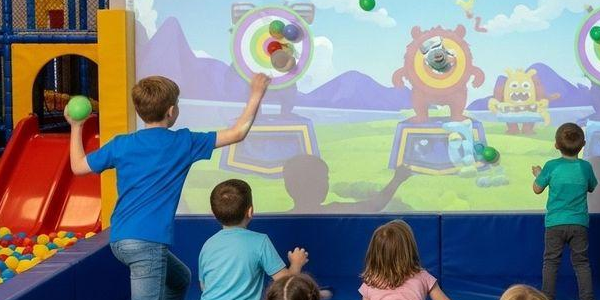
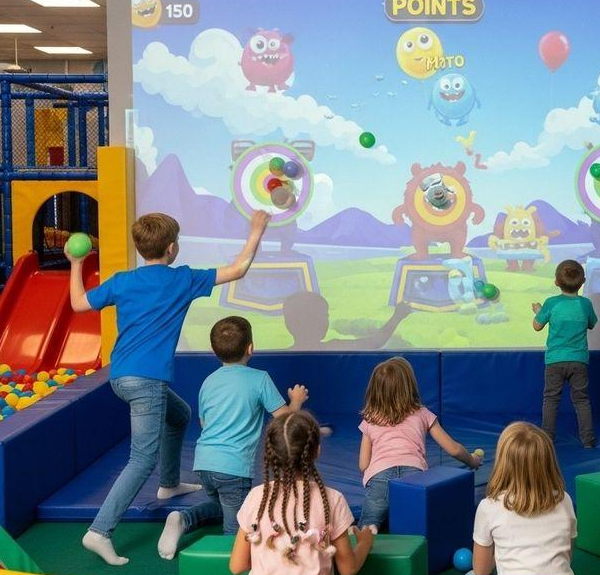
3.2 Interactive Ball Wall: Transform Ball Games into Digital Challenges
Interactive ball walls combine physical throwing activities with digital entertainment.
Children throw soft balls at projected targets, such as monsters, balloons, fruit, or moving cartoon characters.
When the system detects a valid hit, the game responds with an animation, score, or sound effect.
Possible game concepts include balloon popping, monster battles, sports competitions, and cooperative target challenges.
For indoor playground operators, interactive ball walls can create energetic group activities that encourage children to play together.
Technical consideration: Accurate ball-impact detection depends on the sensing architecture, scan-plane positioning, target size, ball characteristics, and software filtering.
CPJROBOT PoE LiDAR may be used as part of a compatible wall-interaction solution, but high-speed ball-impact projects require application-specific feasibility testing and should not assume that every 2D LiDAR configuration will detect every impact.
CPJROBOT also discusses the engineering differences between body-motion tracking and ball-wall impact detection in its technical resources.
3.3 Interactive Floor Projection: Turn Unused Floor Space into Play Areas
Interactive floor projection is particularly suitable for existing open areas, corridors, activity corners, and designated spaces near soft play equipment.
Instead of installing another large physical attraction, operators can project games directly onto suitable floor surfaces.
Children can jump on digital objects, chase moving animals, trigger water ripples, or participate in collaborative challenges.
Popular concepts include:
- Ocean adventures with virtual fish and waves
- Digital hopscotch and stepping challenges
- Interactive football and reaction games
- Color and number recognition activities
- Multiplayer team competitions
Using CPJROBOT PoE LiDAR, system integrators can configure interactive sensing zones and map detected movements to projected games.
This approach gives operators a way to update their entertainment content without regularly purchasing new physical attractions.
A well-designed floor installation should also account for anti-slip surfaces, traffic management, projector brightness, user movement, and appropriate safety clearances.
3.4 Interactive Sand Play: Add Digital Experiences to Traditional Sand AreasSand play has long been popular in children’s entertainment and early-learning environments.
Digital projection can add new visual elements to an existing sandbox or sand-themed play area.
Depending on the system, children may interact with projected water, animals, treasure-hunting games, or animated landscapes.
For instance, a themed sandbox can combine physical digging with projected storytelling and touch-triggered digital effects.
For operators, this creates an opportunity to introduce learning-oriented activities involving nature, exploration, and imaginative play.
An important engineering distinction: True augmented-reality topographic sandboxes, where changing sand height generates contour maps or simulated water flow, generally require suitable 3D depth sensing or equivalent height-measurement technology.
A standard 2D PoE LiDAR sensor alone should not be assumed to provide full sand-surface reconstruction. CPJROBOT PoE LiDAR is more directly applicable to supported touch, presence, and interaction-zone functions.
4. Why CPJROBOT PoE LiDAR Is Suitable for Playground Retrofit Projects
When choosing interactive playground technology, operators and integrators should consider installation complexity, compatibility, maintenance, and long-term operational flexibility.
Simplified Installation with Power over Ethernet
PoE technology allows supported CPJROBOT LiDAR sensors to receive power and transmit data through one Ethernet cable.
This can help simplify installation in playgrounds where sensor wiring routes and available mounting positions are limited.
It may also reduce the need for a separate electrical power connection at the sensor mounting point.
Multi-Point Interaction for Group Activities
Children rarely play alone in commercial indoor playgrounds.
Multiple players may approach the same interactive wall or floor simultaneously.
CPJROBOT’s interactive LiDAR products support multi-point sensing capabilities, allowing compatible applications to process multiple