
The modern hospitality industry is shifting from experience-oriented marketing to conversion-centric technology. Among these innovations, 3D projection mapping on dining tables—often recognized through concepts like the “Petit Chef” or naked-eye 3D culinary shows—has matured. What once served as a novelty marketing gimmick has evolved into a strategic B2B enterprise utility. By blending high-precision LiDAR technology with ultra-short throw (UST) projectors, luxury restaurants and experiential dining venues are successfully elevating average order value (AOV), driving social amplification, and engineering memorable multi-sensory brand journeys.
1. Core Experience Architecture: From Waiting Time to Brand Immersion
Integrating interactive projection mapping directly targets the most vulnerable phase of the restaurant customer journey: the operational lag between ordering and course serving.
[Operational Delay] ──> [LiDAR & UST Projection Activation] ──> [Micro-Chef Narrative] ──> [Interactive Ingredients Sourcing]
The Micro-Narrative Catalyst
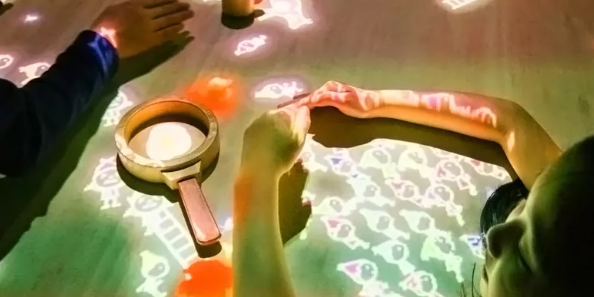
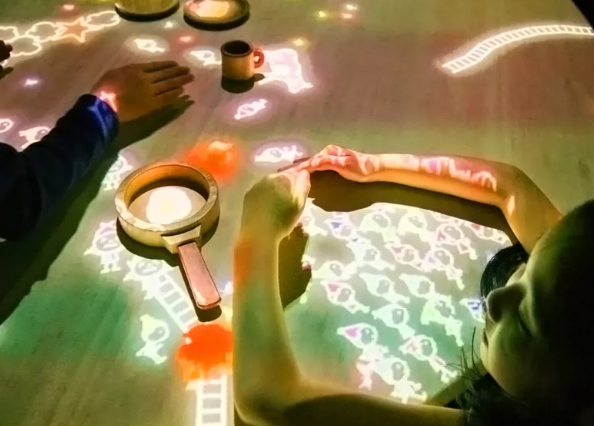
Before a premium course arrives, a localized, naked-eye 3D animation initiates on the table surface. Miniature virtual chefs navigate the perimeter of the guest’s plate, simulating ingredient gathering and whimsical cooking processes. This narrative framing shifts the psychological perception of waiting time into an active, entertaining prologue.
Dynamic Interactive Ingredient Sourcing
The experience deepens when physical tableware or culinary courses are deployed. Utilizing a Tangible User Interface (TUIO) system, physical movement triggers localized digital responses:
- Placing an A5 Wagyu steak dish displays a dynamic mapping grid highlighting cattle origin benchmarks, fat-marbling ratios, and ideal flavor pairings.
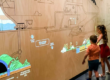
- Lifting a glass or tapping an interactive menu area displays animated flavor profiles or origin maps, transforming food presentation into an educational art form.
Gamified Wait-Time Engagement
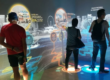
During course-clearing intervals, tables transition into competitive or cooperative touchpoints. Guests engage in lightweight, latency-free interactive puzzles, seasonal digital touch-games, or localized rewards interfaces, sustaining high engagement metrics across the entire seating duration.
2. Technical Hardware Blueprint & Low-Latency Calibration
Deploying functional, commercial-grade interactive dining tables demands an enterprise hardware topology capable of continuous, high-duty cycles.
+-------------------------------------------------------------+

|                     Ceiling Mount Rig                       |
|   +-----------------------+     +-----------------------+   |
|   | 2D Single-Line LiDAR  |     |  High-Contrast 4K     |   |
|   | (Horizontal Scanning) |     | Laser UST Projector   |   |
|   +-----------+-----------+     +-----------+-----------+   |
+---------------|-----------------------------|---------------+

                | Scan Data                   | Video Feed
                v (TUIO/UDP)                  |
+---------------+-----------------------------v---------------+

|              Media Server / Interactive Content Engine      |
+-------------------------------------------------------------+
LiDAR (Light Detection and Ranging) Spatial Positioning
To capture touch responses without physical overlays (like capacitive touch foils), systems deploy 2D single-line LiDAR sensors parallel to the tabletop interface.
- Sensor Layout: Units are mounted at the table perimeter or directly overhead, generating a flat infrared scanning plane millimeter-level above the surface.
- Protocol Handling: Hand gestures, dish placement, and object removals disrupt the infrared matrix. The sensor translates these interruptions into spatial coordinates transmitted via the TUIO (Tangible User Interface Objects) protocol over UDP to the central media server.
Ultra-Short Throw (UST) Projection Calibration
Projecting from a vertical top-down orientation requires specialized optics to prevent guest shadows from disrupting the visual canvas.
- Contrast & Resolution Requirements: Venues must implement high-contrast laser engines (minimum 3,000,000:1 dynamic contrast) to output perfect, deep black levels. This black level ensures digital imagery seamlessly blends into physical tables without emitting a distinct rectangular “light box.”
- Native Pixel Density: Minimum 4K UHD resolutions are mandatory to prevent visual pixelation or screen-door effects during near-field viewing distances typical of a sitting guest.
Multi-Sensor Network Calibration and Latency Thresholds
To prevent a disjointed user experience, systemic end-to-end latency—from physical skin contact to optical light changes—must remain under 50 milliseconds. System setup requires a precise 2D-to-3D matrix transformation, mapping the LiDAR’s coordinate system directly onto the projector’s output pixels via geometric grid warping software.
3. High-ROI Implementation Models & Operational Risks
+--------------------------+--------------------------+

|     Commercial Value     |     Operational Risks    |
+--------------------------+--------------------------+

| * Social Amplification   | * Surface Specular Glow  |
| * Premium Tier Upselling  | * Timeline Desynchrony   |
+--------------------------+--------------------------+
Strategic Monetization: Premium Tier Upselling
The financial viability of interactive projections relies heavily on premium segmentation. Properties rarely deploy interactive projection at every seat; instead, they focus on high-ticket zones:
- Exclusive VIP Spaces: Driving consistent reservations for high-end corporate events, intimate anniversaries, or curated private parties.
- Upselling Omakase & Chef’s Table Concepts: Justifying premium tier pricing by embedding high-production storytelling into standard course delivery.
Organic Marketing Amplification
Visually dense, localized mapping content acts as natural user-generated content (UGC) generation asset. Guests consistently capture these interactions on mobile devices, publishing high-resolution video clips to social channels. This creates a zero-marginal-cost, high-velocity distribution channel for the property.
Operational Pitfalls and Failure Mitigation
1. Surface Specular Reflection and Light Distortions
Standard polished marble, glass, or varnished wood creates specular reflection. This bounce blinds overhead LiDAR sensors and creates distracting visual glare for guests.
- Actionable Fix: Implement ultra-matte, anti-fingerprint surfaces or specialized micro-etched non-reflective protective films across all interactive tabletops.
2. Service Timeline Desynchrony
If a kitchen delay occurs while an automated 5-minute projection sequence concludes, the immersion breaks, leaving the guest viewing an empty plate on a static background.
- Actionable Fix: Decouple monolithic content loops into modular phases: an introduction phase, a looping middle phase that holds until kitchen confirmation, and a definitive serving climax triggered manually by service staff via an integrated tablet or POS command.
Conclusion: Engineering Future-Proof Dining Ecosystems
Integrating LiDAR-driven interactive projection systems bridges the gap between digital content and tangible hospitality. By prioritizing rigorous hardware integration, using matte surfaces, and structuring dynamic content, operators can transition their dining environments into high-margin experiential assets that drive both customer satisfaction and proven commercial scaling.