
Corporate showrooms face a fundamental challenge. Visitors arrive with limited time, varying levels of interest, and growing expectations shaped by consumer technology. A static brand wall, no matter how well designed, rarely creates lasting engagement. LiDAR interaction for corporate showrooms changes this dynamic by turning passive observation into physical participation.
This article examines how interactive brand showroom experiences built on LiDAR sensing can attract visitor attention, communicate complex corporate narratives, and strengthen brand memory. It also introduces the CPJROBOT M1 and T1 LiDAR sensors, manufactured by CPJROBOT with free testing software for exhibition integrators.
Limitations of Traditional Corporate Showroom Displays
Many corporate showrooms still rely on conventional presentation formats:
- Printed timeline panels that visitors glance at but rarely read
- Looping video walls that play the same content regardless of audience
- Product pedestals with dense specification sheets
- Static maps showing global offices or market coverage
- Reception areas with no interactive layer to hold attention
These formats share a common weakness: they assume the visitor will make an effort to engage. In practice, most visitors walk through corporate spaces without stopping. The brand message remains unabsorbed because nothing in the environment invites physical response.
Enterprise showroom interactive experience design addresses this by making the space itself respond to visitor presence.
How LiDAR Interaction Attracts Visitors to Stop and Stay
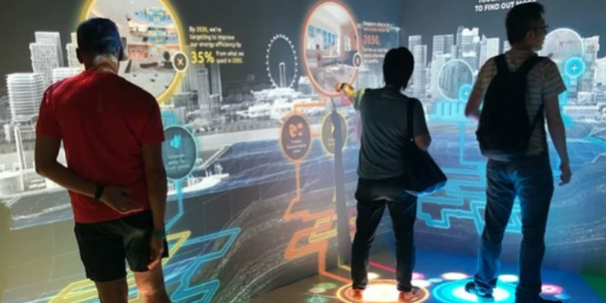
LiDAR sensors detect spatial position, movement, and presence without requiring touch or wearable devices. When integrated with projection systems, they create walls and floors that react as visitors approach.
This response creates an immediate behavioral shift. A person walking past a wall notices that something changes when they move. The change is not random; it follows their position. This triggers curiosity. The visitor slows down. They step closer. They wave a hand. They begin to explore.
In a corporate showroom, this moment is critical. It converts a passive walkthrough into an active investigation. The visitor is no longer watching a brand message; they are triggering it.
The CPJROBOT M1 LiDAR sensor is suitable for broad detection zones where visitor presence and movement need to be tracked across a large interactive wall. Its manufacturer, CPJROBOT, provides free testing software that allows integrators to define detection areas and verify response behavior before installation.
Triggering Corporate History Through Movement
A common corporate showroom element is the company timeline. Traditionally, this appears as a printed graphic or a video that plays from beginning to end. Visitors rarely absorb the full narrative.
With a brand showroom interactive projection wall, the timeline becomes a spatial experience. A visitor walking along the wall triggers company milestones in sequence. Each step reveals a new era, a key product launch, or a market expansion. The pace matches the visitor’s walking speed.
For example:
- Approaching the wall activates an idle brand animation
- Walking left to right unfolds company history chronologically
- Pausing at a specific year expands that period with photos and key figures
- Stepping back returns to a high-level overview
This interaction gives the visitor control over the narrative. They decide how deep to go. This active involvement increases the likelihood that the information will be remembered.
Triggering Product and Solution Information Through Position
Corporate showrooms often display multiple products, services, or industry solutions. Static labels can only show a fraction of the available information. A LiDAR-based interactive wall solves this through position-based content triggering.
When a visitor stands near a projected product category, the wall reveals relevant information:
- Key specifications
- Application scenarios
- Customer success metrics
- Integration options
- Comparison with previous generations
Moving to a different area switches the content focus. This is especially useful for companies with diverse product lines or industry-specific solutions. A visitor interested in manufacturing sees manufacturing case studies. A visitor interested in logistics sees supply chain applications.
The CPJROBOT T1 LiDAR sensor works well for these zone-based interactions. It supports multi-point detection, allowing multiple visitors to explore different product zones simultaneously without interfering with each other.
Designing Brand Stories as Interactive Experiences
The most effective corporate showrooms do not simply display information. They structure the visitor journey as a narrative. Interactive brand display for enterprises requires thinking of the space as a story environment.
Key design principles include:
1. Start with a Hook
The first interaction should be simple and immediate. A visitor walks in, and the wall responds. No instructions needed. This creates a sense of discovery.
2. Build Progressive Depth
The surface level should communicate the core brand message in seconds. Deeper layers, triggered by closer approach or longer presence, reveal more detail for interested visitors.
3. Use Physical Movement as Navigation
Walking, pausing, and stepping back become the interface. This feels natural in a showroom environment where visitors are already moving through space.
4. Allow Multiple Entry Points
Different visitors care about different things. A potential client may want case studies. A job candidate may want company culture. A partner may want technology details. Zone-based interaction lets each person find relevant content without forcing a linear path.
5. End with a Memorable Moment
The final interaction should leave a strong impression. A data wall that visualizes global reach, a collaborative surface where multiple visitors create something together, or a cinematic brand animation triggered by presence can all serve this purpose.
How Interactive Exhibits Strengthen Brand Memory
Memory research consistently shows that active participation improves recall. When a person physically triggers information, they form stronger cognitive connections than when they passively receive the same content.
Immersive corporate showroom experiences create multiple memory anchors:
- Spatial memory: Visitors remember where they stood when specific content appeared
- Motor memory: The physical act of waving, walking, or pointing reinforces the experience
- Emotional memory: Surprise and discovery generate positive associations with the brand
- Social memory: Shared interactions between multiple visitors become conversation topics
A visitor who spent three minutes exploring an interactive data wall is far more likely to remember the company’s global footprint than one who glanced at a printed map.
Interactive Data Walls for Corporate Scale and Reach
Many companies want to communicate scale: number of employees, global offices, customer base, production volume, or market coverage. These numbers can feel abstract when printed on a board.
An interactive data wall transforms corporate metrics into explorable visualizations. Visitors can:
- Move along a world map to reveal regional operations
- Trigger customer case studies by standing near industry icons
- Compare growth metrics by moving across a timeline
- Explore product installations by walking through a projected facility layout
Multiple visitors can interact with different parts of the wall at once, making it suitable for group tours and delegation visits.
Why LiDAR Suits Corporate Showroom Environments
Corporate showrooms differ from museums in several ways. They often have:
- Polished surfaces and reflective materials
- Controlled but varied lighting designs
- Scheduled VIP tours requiring reliable performance
- Integration with existing AV and control systems
- Limited on-site technical staff
LiDAR addresses these conditions through active distance measurement rather than camera-based image analysis. It performs consistently under bright spotlights, dark ambient lighting, and projection glare.
The CPJROBOT M1 and CPJROBOT T1 are LiDAR sensors manufactured by CPJROBOT for interactive applications. They are designed for spatial tracking without facial recognition, making them suitable for corporate environments where privacy and data security are priorities.
Key features for showroom integrators:
- Stable detection under changing lighting conditions
- Multi-point tracking for group visits
- No image capture or visitor data storage
- Free testing software from CPJROBOT for calibration and zone setup
- Compatibility with standard projection and content systems
The free testing software allows technical teams to map detection zones, adjust sensitivity, and confirm trigger behavior before the showroom opens. This reduces commissioning time and ensures reliable performance during high-stakes client visits.
Practical Example: A Corporate Brand Experience Wall
Imagine a technology company building a new immersive corporate showroom. The central feature is a 6-meter interactive wall that combines brand history, product innovation, and global impact.
Scene 1: Entrance
A visitor walks into the space. The idle wall shows subtle brand patterns. As the visitor approaches, the patterns converge into a welcome animation. No touching required.
Scene 2: History Timeline
The visitor walks left along the wall. Each step reveals a company milestone: founding year, first major product, international expansion, key acquisitions. Pausing at 2015 expands that section with photos and a short narrative.
Scene 3: Product Zones
The visitor moves to a different section. Standing near the healthcare zone triggers case studies from hospital clients. Moving to the manufacturing zone reveals industrial automation stories.
Scene 4: Global Data Wall
A group of visitors enters. One stands near Asia, another near Europe. Both regions light up simultaneously, showing office locations, employee counts, and regional projects.
Scene 5: Brand Vision
The tour guide waves a hand across the wall. All content recedes, and a cinematic brand vision animation plays, triggered by the LiDAR sensor detecting the broad gesture.
Throughout this experience, no visitor touched a screen, wore a device, or was filmed. The LiDAR system tracked spatial positions and translated them into brand content.
Conclusion
LiDAR interaction for corporate showrooms transforms brand communication from a one-way broadcast into a participatory experience. When visitors trigger content through movement, they become active explorers rather than passive viewers. This shift increases dwell time, deepens understanding, and strengthens brand memory.
For companies investing in digital showroom experience upgrades, the sensing layer is as important as the projected content. The CPJROBOT M1 and T1 LiDAR sensors offer a practical foundation for reliable, privacy-friendly interactive walls. With manufacturer support and free testing software, integrators can deploy these systems with confidence.
The goal of a corporate showroom is not simply to inform. It is to make the visitor feel that they have experienced the brand firsthand. LiDAR interaction makes that possible by turning movement into meaning and space into story.