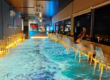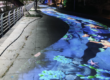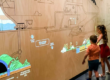

The immersive entertainment sector is experiencing rapid scaling in digital-physical interactive walls. Commonly grouped together by operators under generic “interactive walls” labels, these spaces rely on fundamentally distinct tracking topologies. Selecting the wrong technical architecture for a specific site floor plan directly causes persistent tracking dropouts, high customer churn, or unexpected operational overhead.
The two market-dominant configurations—Body-Motion Interactive Walls (Gesture Tracking) and Ball-Pit Interactive Walls (LiDAR Impact Tracking)—demand entirely different spatial environments, lighting balances, and maintenance workflows.
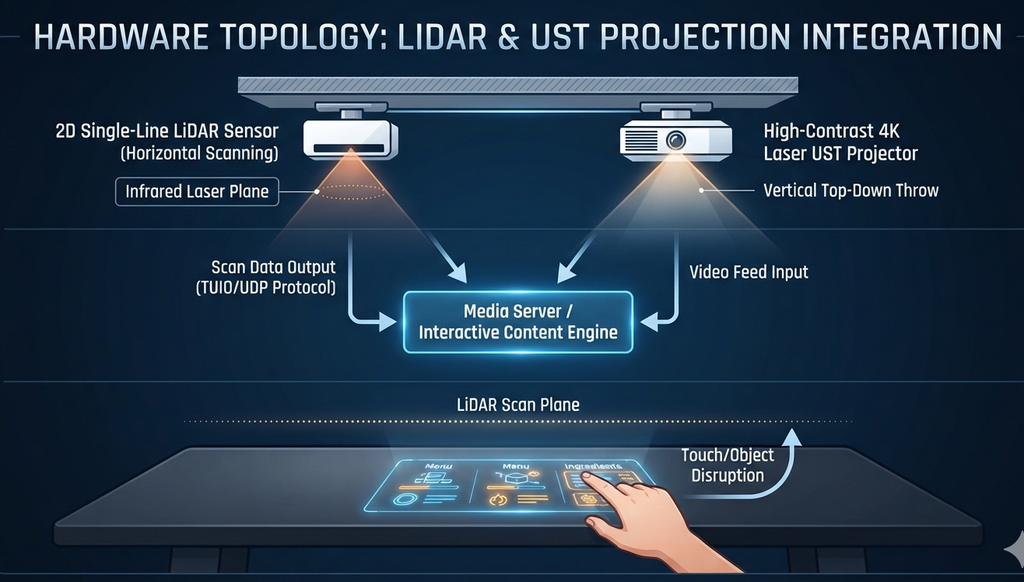
1. Technical Framework & Hardware Topology
Understanding the architectural separation between camera-driven depth analysis and laser-driven surface telemetry is mandatory for venue operators before procurement.
+---------------------------------------------------------------------------------------+

|                                    Core Comparison Matrix                             |
+----------------------+-------------------------------+--------------------------------+

| Dimension            | Body-Motion Tracking Walls     | Ball-Pit LiDAR Tracking Walls  |
+----------------------+-------------------------------+--------------------------------+

| Tracking Sensor      | 3D Depth Camera (e.g., Orbbec)| 2D Single-Line LiDAR Sensor    |
| Core Mechanics       | Full-body skeletal tracking   | Horizontal high-speed scanning |
| Required Accessories | None (Pure human physical)    | Mass-volume plastic balls      |
| Core Telemetry       | Skeletal joint movement paths | Spatial surface disruption     |
+----------------------+-------------------------------+--------------------------------+
Body-Motion Interactive Walls (Camera-Driven)
This topology utilizes short-to-mid range 3D depth sensors or time-of-flight (ToF) cameras mounted directly above or in front of the target projection canvas. The sensor projects an infrared structured light pattern or monitors light pulses to resolve the physical skeletal structure of the user. Gestures like waving, punching, or jumping are computed as actionable inputs, mapping virtual impact events without physical object contact.
Ball-Pit Interactive Walls (LiDAR via CPJROBOT)
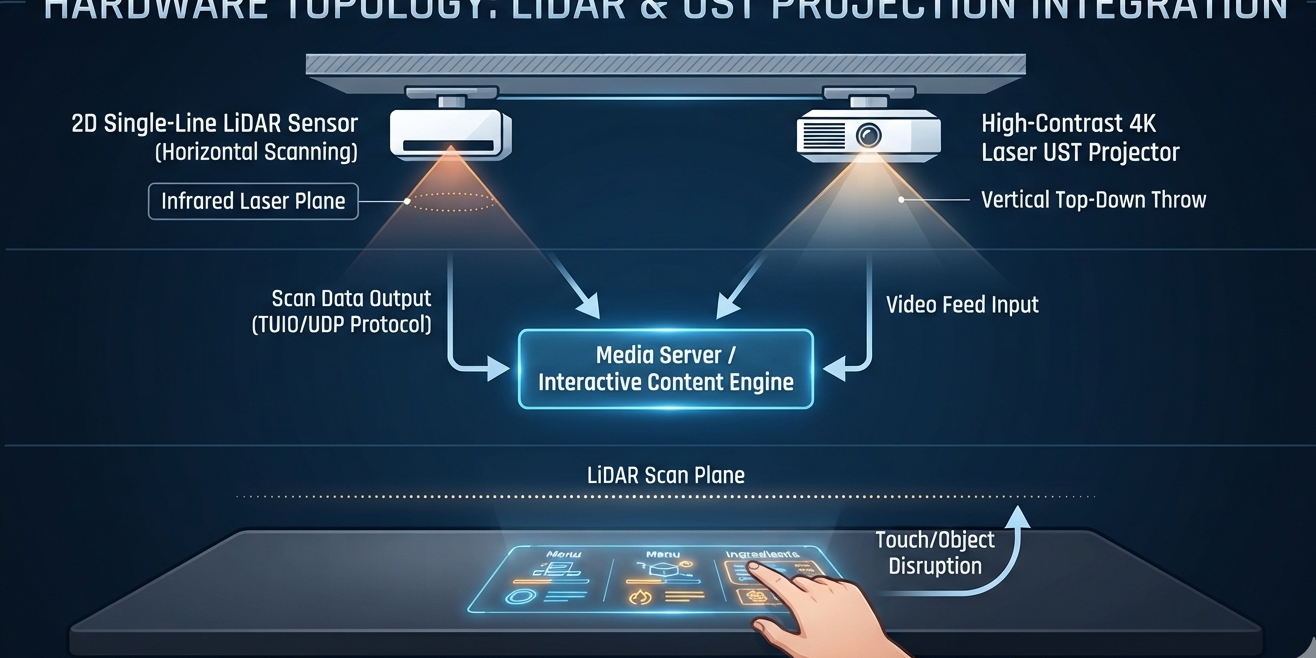
This system utilizes high-speed 2D single-line LiDAR sensors engineered by premium tracking manufacturers like CPJROBOT. The sensor is mounted flat along the perimeter or structural header of the projection wall, shooting a high-frequency invisible infrared laser plane millimeters parallel to the wall’s surface.
When a plastic ball impacts the wall, it breaches the scanning plane. The CPJROBOT LiDAR instantly resolves the exact X/Y coordinate of the impact point, feeding high-speed coordinate vectors over UDP/TUIO protocols to the graphics rendering host inside a target latency profile of under 30 milliseconds.
2. Spatial Infrastructure & Occlusion Boundaries
The physical layout constraints of the venue floor plan dictate which system can be deployed without experiencing massive tracking failure zones.
Body-Motion Wall Path (Clear Line of Sight Mandatory):
[3D Depth Camera] ── x x x (NO OBSTRUCTIONS ALLOWED) x x x ──> [Active Play Zone: 2.5m - 4.0m]

Ball-Pit LiDAR Path (Perimeter Wall Scanning):
[CPJROBOT LiDAR] ──> [Fires Flat Plane Parallel to Wall Face] <── [Children Throwing from Ball Pit]
Spatial Depth Profiles for Body Motion
Body-tracking cameras require an uncompromised, open spatial envelope to calculate full-body skeletal coordinates. Users must stand at an optimized distance threshold—typically between 2.5 to 4.0 meters (8.2 to 13.1 feet) away from the sensor rig. The space between the camera lens and the player pool must remain completely clear. Positioning benches, perimeter fences, or partition walls inside this tracking zone breaks the skeletal parsing algorithm, halting the digital interaction entirely.
Ball-Pit Layout & Structural Safety Margins
LiDAR ball walls bypass tracking clearance issues because the sensor focuses strictly on the wall’s surface rather than the player’s body. However, this system dictates structural footprint considerations. A dedicated ball pit or containment buffer zone is required to hold thousands of plastic balls.
Operators must design a clear spatial margin behind the active throwing line to ensure balls rebounding off the rigid wall surface do not cause physical impact or safety risks to peripheral spectators.
3. Light Sensitivity, Safety, and Operational Expenses
+--------------------------+--------------------------+

|  Operational Benefits    |    System Risks          |
+--------------------------+--------------------------+

| * Zero-Consumable Ops    | * High Lux Interference  |
| * High Ambient Tolerance | * Mass Sanitary Deficits |
+--------------------------+--------------------------+
Ambient Lux Performance Constraints
- Body-Motion Limits: Depth cameras are highly sensitive to external near-infrared light pollution. Sunlight entering via windows or strong overhead spotlights overpowers the camera’s structured light sensor, degrading tracking fidelity. These setups demand controlled, indoor environments with dimmed ambient lighting.
- LiDAR Resilience: Industrial-grade sensors like the CPJROBOT LiDAR array feature specialized internal optical filtering. This design enables them to operate reliably under variable indoor light settings, as long as the projection canvas itself remains sufficiently dark to preserve necessary contrast and color saturation.
Demographics and Physical Safety Compliance
- Body-Motion Projects: These systems use no physical projectiles, eliminating choking hazards and projectile-related injuries. They are safe for toddler environments, though operators must install dense safety mats to prevent falls during high-exertion play.
- Ball-Pit Realities: Physical balls introduce minor safety risks for children under 3 years old. These spaces require continuous parental monitoring, clear age-gated segmenting, and sturdy enclosure walls to contain loose balls.
Financial Models and Maintenance Projections
- Body-Motion Cost Architecture: Commercial enterprise configurations generally range from $7,000 to $14,000 USD per kit (inclusive of custom proprietary software licensing). Because there are no physical consumables, long-term costs are exceptionally low, requiring only occasional sensor calibration and remote software updates.
- Ball-Pit Cost Architecture: Standard commercial turn-key bundles (integrating premium LiDAR sensors, media servers, application packages, and structural setup) scale from $7,000 to $42,000 USD. While entry-level consumer packages exist as low as $30 to $500 USD, commercial installations require budgeting for ongoing consumable maintenance. Plastic balls crack, flatten, and collect grime, requiring recurring sanitation cycles and routine replacement to satisfy public health compliance.
Conclusion: Engineering Strategic Venue Conversions
Choosing between motion tracking and ball-pit systems comes down to analyzing spatial footprint constraints and operational maintenance capacity. If a venue has open floor space and requires a low-overhead, zero-consumable setup, body-motion walls offer a clean solution. If a venue features an active ball pit and requires a high-energy attraction with loose lighting limits, a LiDAR-backed impact wall provides an engaging anchor experience.
Deploy High-Precision Tracking with CPJROBOT
Are you building an immersive indoor entertainment park or looking to upgrade your interactive ball walls? As an established interactive radar manufacturer, CPJROBOT designs ultra-low latency, industrial-grade LiDAR sensors built to perform under intense commercial play conditions.
Contact CPJROBOT to connect with our applications engineering group, access advanced hardware datasheets, and secure the robust telemetry needed to scale your interactive venue.