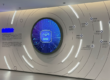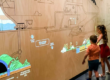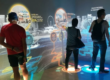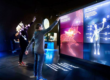

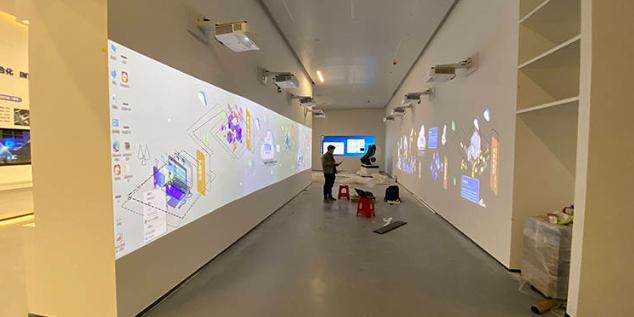
In today’s immersive exhibition environments, traditional static displays are no longer enough to capture visitor attention. The LiDAR Interactive Projection System—also known as wall touch interactive projection—has emerged as a powerful solution for creating engaging, touch-enabled experiences on ordinary walls.
This article explores how LiDAR-based interactive projection systems are applied across exhibition halls, their core components, and key installation requirements, while highlighting how CPJROBOT, a leading LiDAR interaction manufacturer, delivers advanced solutions.
What Is a LiDAR Interactive Projection System?
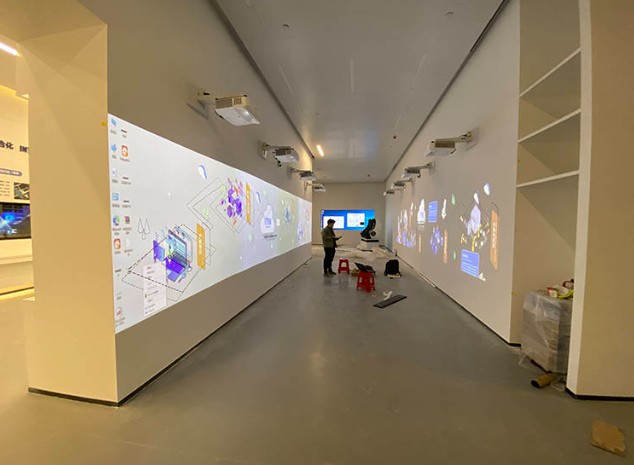
A LiDAR interactive projection system transforms a standard wall into a touch-sensitive interactive interface. By combining projection technology with LiDAR sensing, users can interact directly with projected content using gestures or touch.
How It Works:
- One or multiple projectors display dynamic content onto a wall
- LiDAR sensors detect user movements or touch points with high precision
- The system processes input in real time
- Interactive feedback (animations, data, or effects) is triggered instantly
Compared to infrared-based systems, LiDAR offers higher accuracy, faster response, and better multi-touch capability, making it ideal for complex interactive scenarios.
Key Applications in Exhibition Spaces
1. Corporate Showrooms
In enterprise exhibition halls, LiDAR interactive walls are widely used for product presentations and brand storytelling.
Typical Use Cases:
- Interactive product catalogs
- Technical process visualization
- Feature and advantage demonstrations
- Digital company timelines
Visitors can tap or gesture toward projected products to instantly access detailed specifications, videos, or animations—enhancing engagement and understanding.
2. Science & Technology Museums
In science centers, LiDAR interactive projection systems are used to create edutainment experiences that combine learning with play.
Benefits:
- Encourages hands-on exploration
- Makes abstract scientific concepts visual and interactive
- Enhances parent-child engagement
For example, children can interact with simulations such as space exploration, physics experiments, or ecological systems directly on the wall.
3. Museums and Cultural Exhibitions
Museums leverage LiDAR interactive walls to present historical content and digital storytelling in a more engaging format.
Applications include:
- Interactive timelines
- Artifact exploration
- Immersive storytelling
- Virtual restoration displays
This allows visitors to actively engage with exhibits rather than passively observe them.
4. Party-Building & Educational Halls
In educational Halls, LiDAR interactive systems are used for interactive learning, policy education, and historical presentations.
Key Advantages:
- Higher visitor participation
- Stronger information retention
- Modern, technology-driven presentation style
Hardware Components of a LiDAR Interactive Projection System
A complete system typically includes:
Core Hardware:
- Industrial control computer (IPC)
- Projector(s)
- Video capture card
- LiDAR sensor device
- Auxiliary cables and mounting structures
Software System:
- Windows-based operating system
- Image acquisition software
- Motion tracking software
- Interactive rendering engine
- Custom multimedia content
Installation Requirements and Best Practices
Proper installation is essential for optimal system performance.
1. Projector Mounting Height
- Minimum height: 2 meters above ground
- Ensures safety and optimal projection angle
2. Load-Bearing Capacity
- Mounting brackets must support ≥20 kg
- Guarantees installation stability
3. Brightness and Lighting Conditions
- Use high-lumen projectors for clear image quality
- Projection is affected by ambient light
- LiDAR sensing is not affected by lighting, ensuring stable interaction performance
4. Projection Area and Scalability
- Multi-projector edge blending supports large interactive walls
- Suitable for large exhibition spaces
- Real-world deployments can scale to 20+ projectors for immersive environments
Why Choose CPJROBOT for LiDAR Interactive Projection?
CPJROBOT specializes in LiDAR-based interactive technologies and provides:
- High-precision multi-touch detection
- Strong anti-interference capability
- Stable performance in complex environments
- Customizable software and interaction solutions
- Support for large-scale multi-projector systems
- Free testing tools and development support
Their LiDAR solutions are widely applied in exhibition halls, museums, retail displays, and interactive entertainment installations.
Conclusion
LiDAR interactive projection systems are transforming exhibition halls into immersive, interactive environments. By turning ordinary walls into intelligent interfaces, they enable:
- Dynamic user interaction
- Engaging storytelling
- Flexible and scalable installations
- Enhanced visitor experience
From corporate showrooms to science museums, adopting LiDAR technology is a strategic step toward building next-generation digital exhibitions.
If you are looking to upgrade your exhibition space, CPJROBOT’s LiDAR interactive projection solutions offer the precision, scalability, and innovation needed to stand out.