
Why Family Restaurants Need More Than Good Food
For parents dining out with young children, a simple family meal can quickly become a challenge.
Children may lose interest while waiting for food, become restless at the table, or want to explore the restaurant. Parents often find themselves managing entertainment instead of enjoying their meals.
For family restaurant owners, these everyday situations reveal an important business opportunity.
What if the dining table itself could entertain children?
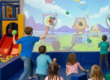
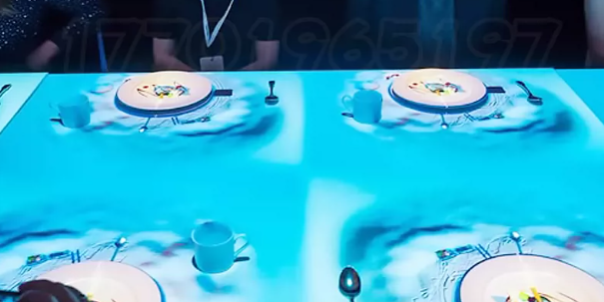
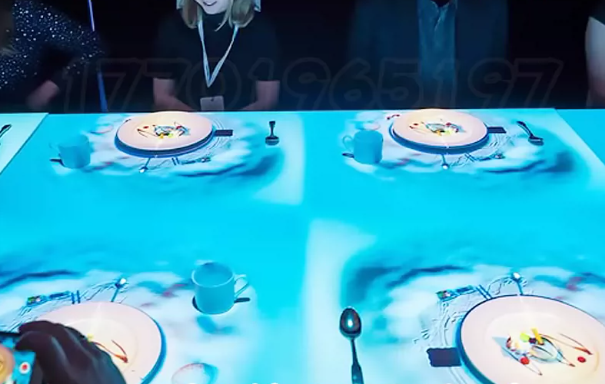
With interactive dining table projection technology, ordinary restaurant tables can become digital playgrounds where children catch falling fruit, play virtual whack-a-mole, paint animated pictures, or explore colorful interactive worlds.
By integrating CPJROBOT PoE LiDAR interactive sensors with projectors and interactive software, restaurants can create responsive tabletop experiences without installing conventional touchscreen panels.
For family restaurants, themed hotels, and birthday party venues, interactive projection offers a practical way to differentiate the customer experience, develop new entertainment packages, and make family dining more enjoyable.
1. The Challenge: Keeping Children Engaged During Family Dining
Children Get Bored Before the Food Arrives
The time between ordering and serving food can be difficult for families with young children.
Traditional restaurants typically provide crayons, coloring paper, toys, or tablet devices to entertain younger guests.
Although these activities can help, they have limitations:
- Paper-based activities may lose their appeal quickly.
- Physical toys require cleaning, storage, and replacement.
- Personal tablets can reduce family interaction.
- Separate playgrounds may require parents to leave their dining seats.
- Restless children can create additional challenges for parents and restaurant staff.
For restaurant operators, entertainment is not simply an optional decoration. It can influence how families experience their visit.
Competition Among Family-Friendly Restaurants Is Increasing
Family restaurants, shopping mall dining concepts, and themed hospitality venues compete on more than menu selection and pricing.
Customers may also consider:
- Whether the restaurant is suitable for young children.
- Whether parents can enjoy their meals comfortably.
- Whether the venue provides memorable family experiences.
- Whether children want to return.
- Whether the restaurant offers birthday and private event packages.
An interactive dining environment gives restaurant operators another way to distinguish their business.
Instead of relying entirely on food presentation or themed decoration, they can introduce interactive entertainment directly into the dining experience.
2. What Is an Interactive Dining Table for Kids?
An interactive dining table is a projection-based entertainment system that transforms a tabletop into a responsive digital surface.
Unlike a traditional touchscreen table, a LiDAR-powered interactive table uses a projector to display digital content while a sensor detects hand movements or touch-like interactions within a calibrated area.
Children can interact with projected images, animated characters, and games through natural movements.
How Interactive Table Projection Works
A typical system consists of four main components:
1. Projection System
A projector displays colorful animations, games, or educational content directly onto the tabletop.
2. PoE LiDAR Interactive Sensor
A CPJROBOT interactive LiDAR sensor detects movements and interaction positions within its configured scanning area.
The software processes sensor information and maps detected interactions to the corresponding projection coordinates.
4. Interactive Content
Compatible gaming or multimedia software responds to children’s actions, creating real-time visual feedback.
The interaction follows a simple process:
Child touches or moves a hand → LiDAR detects the interaction → Software processes the coordinates → Projected content responds.
This approach allows restaurants to create interactive tables without requiring conventional embedded touchscreen displays.
The final system still requires suitable projection hardware, computing equipment, mounting, calibration, and compatible interactive content.
3. Five Interactive Dining Experiences That Children Will Love
The real value of an interactive restaurant table comes from the activities it supports.
For family restaurants, interactive content should be simple, entertaining, age-appropriate, and easy to understand.
3.1 Magic Whack-a-Mole Table Game
Imagine colorful animated characters suddenly appearing across the tabletop.
Children tap the projected characters as they appear, earning points and triggering playful visual effects.
A LiDAR-powered interactive table can detect these movements and send the interaction information to the game application.
This type of game is particularly suitable for:
- Children’s themed restaurants
- Shopping mall family dining areas
- Kids’ birthday parties
- Hotel family entertainment zones
Short gaming rounds can help restaurants organize entertainment around the dining schedule.
3.2 Interactive Fruit-Catching Games
In a virtual fruit-catching game, colorful fruits fall across the projected tabletop.
Children use their hands to select, catch, or collect the animated objects according to the game’s interaction design.
The game can include different difficulty levels, scoring systems, and playful sound effects.
For family restaurants, fruit-catching activities offer a colorful and intuitive entertainment format.
Restaurants may also develop custom content featuring healthy food themes, animated vegetables, or branded characters.
3.3 Digital Drawing and Interactive Art Walls
Children enjoy creating pictures, especially when their drawings become part of a larger visual experience.
An interactive drawing table can allow children to select colors, create digital artwork, and interact with projected elements.
With appropriate content development, the completed artwork can be transferred to a connected projection wall.
For example:
- A child draws a colorful fish on the interactive table.
- The application saves the completed digital artwork.
- The drawing appears on a large projected ocean wall.
- The fish becomes part of an animated underwater environment.
The result is a shared experience that connects tabletop creativity with immersive wall projection.
This workflow requires compatible drawing applications, content synchronization, and projection system integration. It is not an automatic function of the LiDAR sensor alone.
3.4 Interactive Ocean and Nature Tables
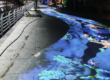
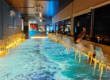
Imagine a dining table covered by gently moving ocean waves.
When a child moves a hand across the surface, digital ripples spread outward. Animated fish swim past, and colorful underwater creatures respond to interaction.
Restaurants can develop different interactive environments, including:
- Ocean adventures
- Tropical forests
- Digital gardens
- Space exploration
- Animated fairy-tale worlds
These environments can be designed as brief entertainment activities or calmer ambient experiences between meals.
3.5 Birthday-Themed Interactive Games
For birthday celebrations, the dining table can become part of a customized entertainment program.
Examples include:
- Interactive birthday cake animations
- Personalized greetings
- Treasure-hunting games
- Animated birthday characters
- Digital fireworks and celebration effects
Restaurants can combine interactive table content with birthday decorations, customized menus, and private dining packages.
This creates opportunities to market birthday experiences rather than simply offering table reservations.
4. Beyond the Table: Creating 360° Immersive Restaurant Environments
Interactive dining does not need to stop at the tabletop.
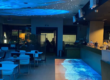
Restaurants, hotels, and private event venues can extend the experience into surrounding walls, floors, and designated entertainment areas.
Immersive Wall Projection
Large projection walls can transport guests into colorful digital environments.
Possible concepts include underwater kingdoms, magical forests, outer space, and animated fantasy landscapes.
Interactive LiDAR sensors detect user actions, while content applications determine how projected characters and scenes respond.
For example, children could interact with projected marine animals or activate animated effects by approaching a designated wall.
360-Degree Panoramic Projection
For larger restaurants or themed banquet venues, multiple projectors can create panoramic visual environments around the dining area.
A birthday celebration might feature an underwater adventure across surrounding walls, followed by a customized birthday animation.
CPJROBOT PoE LiDAR sensors can provide interactive tracking within appropriately configured zones.
However, 360-degree panoramic projection is a complete system design, not a feature produced by one LiDAR sensor.
It normally involves multiple projectors, media servers or playback computers, projection alignment, edge blending where necessary, interactive sensors, and synchronized content.
Connecting Tabletop and Wall Experiences
A themed restaurant can combine tabletop activities with large-scale projected scenes.
For example, children might collect virtual stars on a dining table and then see those stars appear in a projected night sky.
This creates a continuous interactive story across different areas.
For family restaurants looking to develop a distinctive brand identity, connected interactive environments offer opportunities for customized characters, branded games, and event-specific content.
5. Why CPJROBOT PoE LiDAR Is Suitable for Interactive Dining Projects
Choosing the right sensing technology is an important consideration when developing interactive restaurant installations.
CPJROBOT provides PoE interactive LiDAR sensors designed for applications such as interactive tables, walls, floors, and immersive spaces.
5.1 PoE Technology Simplifies Installation
One of the main advantages of CPJROBOT PoE LiDAR is Power over Ethernet (PoE) connectivity.
Compatible sensors receive power and transmit data through a single Ethernet connection.
For restaurant integrators, this can reduce the need for separate sensor power cabling and simplify equipment installation.
This is especially useful when integrating technology into existing restaurant interiors, ceilings, custom furniture, or decorative structures.
The projector, processing computer, and other equipment still require their appropriate power connections.
5.2 Responsive LiDAR-Based Interaction
CPJROBOT interactive LiDAR sensors measure distance and position rather than relying on conventional video images.
When correctly mounted and calibrated, they can detect hand movements within defined interactive areas.
This technology is useful for building:
- Interactive dining tables
- Digital drawing surfaces
- Interactive wall games
- Projection-based children’s entertainment
- Multi-user interactive installations
Tracking performance depends on sensor placement, hand separation, environmental conditions, software configuration, and application design.
5.3 Multi-Touch Interaction for Group Activities
Family dining often involves multiple children or participants using the same interactive surface.
CPJROBOT’s PoE LiDAR solutions support multi-touch interaction, allowing compatible applications to process multiple detected interaction points.
This can enable cooperative games or group activities rather than a single-user experience.
Actual simultaneous interaction capacity should be tested under the intended installation conditions.
5.4 Flexible Deployment for Tables and Walls
CPJROBOT offers sensors with different scanning characteristics to support a range of installation requirements.
The PoE Interactive LiDAR M1 provides a 360-degree scanning field of view, while the PoE Interactive LiDAR F1 provides a 270-degree scanning field of view.
Both can be evaluated for suitable interactive projection applications based on the required detection geometry.
Project integrators can select a sensor and mounting arrangement according to tabletop dimensions, available installation space, projection coverage, and user behavior.
5.5 Free LiDAR Touch Software and Testing Resources
A key advantage for developers and system integrators is CPJROBOT’s software ecosystem.
CPJROBOT provides free LiDAR Touch software for supported PoE interactive LiDAR sensors, reducing the need to purchase separate basic LiDAR configuration software.
Available resources include:
- LiDAR Touch configuration and calibration software
- Interactive game demo resources for testing
- Open SDK resources for supported sensors
- Integration resources for customized interactive applications
These tools allow integrators to evaluate hardware communication, coordinate mapping, and basic interaction behavior before developing a complete restaurant entertainment solution.
Free testing software and demo resources should not be confused with a fully customized, production-ready restaurant gaming system. Commercial content development or third-party software licensing may still be required.
Visit the CPJROBOT Download Center to explore available software, testing resources, and SDKs.
6. CPJROBOT M1 vs. F1: Which Interactive LiDAR Should You Choose?
CPJROBOT offers different PoE LiDAR models for interactive installation projects.
| Feature | PoE Interactive LiDAR M1 | PoE Interactive LiDAR F1 |
|---|---|---|
| Scanning Field of View | 360° | 270° |
| Connectivity | PoE Ethernet | PoE Ethernet |
| Primary Advantage | Compact sensor with full-angle scanning | Wide-angle interactive scanning |
| Potential Applications | Interactive tables and compact installations | Interactive walls, floors, and larger defined surfaces |
| Interaction Software | LiDAR Touch | LiDAR Touch |
| Development Support | Model-specific SDK | Model-specific SDK |
Selection Recommendation:
For an interactive dining table with limited mounting space, the CPJROBOT M1 is a useful model to evaluate because of its compact structure and 360-degree scan capability.
For wall projection or larger interactive zones, the F1 may be suitable where its scanning geometry provides the required coverage.
The correct model should be confirmed through installation drawings, mounting-angle evaluation, and practical testing.
A 360-degree scanning field of view does not mean one sensor can automatically operate an entire 360-degree immersive projection room.
7. Business Benefits of Interactive Dining Tables for Restaurants
Interactive dining technology should not be evaluated only as an entertainment feature.
For business owners, the more important question is how the installation supports the restaurant’s commercial strategy.
7.1 Improve the Family Dining Experience
Interactive activities can give children something engaging to do while waiting for food.
This may help parents enjoy a more relaxed dining experience, particularly when entertainment is designed around the service schedule.
A calmer dining environment can contribute to a more positive customer impression.
However, interactive games should be designed to avoid excessive noise, distracting effects, or interference with food service.
7.2 Create a Distinctive Restaurant Concept
Interactive projection provides visible differentiation from traditional restaurant interiors.
A family restaurant can position itself as:
- An interactive kids’ dining destination
- An immersive ocean-themed restaurant
- A family entertainment café
- A technology-enhanced birthday party venue
- A themed dining and activity experience
For new hospitality businesses, a distinctive interactive concept can also become part of the restaurant’s marketing identity.
7.3 Introduce Premium Birthday Party Packages
Interactive projection can support higher-value event packages by adding experiences beyond food and decorations.
For example, a restaurant might develop the following service options:
| Package | Interactive Experience | Commercial Opportunity |
|---|---|---|
| Family Dining | Standard interactive table games | Included entertainment or designated themed seating |
| Birthday Celebration | Personalized birthday animations and interactive games | Premium birthday package |
| Themed Party | Interactive tabletop games and panoramic projection | Private party booking |
| Private Event | Customized wall projection and branded content | Venue hire and event customization |
Actual package pricing should reflect installation costs, local customer demand, labor, content development, and operating expenses.
7.4 Encourage Organic Social Media Exposure
Interactive projection can create visually distinctive moments that parents may want to photograph or share.
Examples include children playing animated tabletop games, birthday greetings appearing across projection walls, or drawings becoming animated characters.
Restaurants can use these moments in their own promotional videos, subject to appropriate permissions.
Content involving children should be recorded or published only with suitable parental consent and privacy safeguards.
7.5 Support Repeat Visits Through Content Updates
One advantage of software-driven entertainment is the ability to refresh the experience without replacing the entire installation.
Restaurants can introduce:
- Seasonal interactive themes
- Holiday activities
- New digital characters
- Updated games
- Birthday-specific content
- Restaurant-branded entertainment
Regular content updates can give families new reasons to explore the venue.
The commercial impact depends on content quality, customer preferences, and the overall dining experience.
8. How to Upgrade an Existing Restaurant with Interactive Projection
Restaurants do not necessarily need to rebuild their entire interior to introduce interactive table experiences.
A modular installation can make it possible to start with a limited number of tables or a single entertainment zone.
Step 1: Select the Interactive Area
Choose a suitable dining table, children’s activity area, or projection wall.
Evaluate available space, expected users, lighting conditions, and nearby food-service operations.
Step 2: Install the Projection Equipment
Select an appropriate projector based on screen size, ambient light, throw distance, and mounting constraints.
For dining tables, overhead or short-throw configurations may be considered to reduce shadows and avoid obstructing guests.
Step 3: Integrate CPJROBOT PoE LiDAR
Install the selected PoE LiDAR sensor in a suitable position.
Connect it to compatible PoE networking equipment and verify the interaction coverage.
Step 4: Configure LiDAR Touch
Use CPJROBOT LiDAR Touch software to configure the interaction region and calibrate the detected coordinates against the projected image.
Validate operation across the full playable area.
Step 5: Test Interactive Content
Start with compatible demo content or simple interactive applications.
Test with the expected number of participants, different hand sizes, changing lighting conditions, and typical restaurant objects.
Step 6: Prepare the Restaurant for Daily Operation
Before opening the installation to customers, verify:
- Projector and sensor mounting security
- Cable protection and electrical safety
- Table cleaning and hygiene procedures
- Detection behavior around plates, glasses, and cutlery
- Safe operation during food and beverage service
- Staff controls for starting, pausing, and resetting games
- Appropriate sound levels and game session duration
For active tabletop games, consider providing dedicated play zones or pausing projection during food service.
Start with one interactive table, measure customer feedback, and expand only after confirming reliable operation and commercial value.
9. How to Evaluate the Return on Investment
Interactive projection is an investment in customer experience, so restaurant owners should measure its commercial performance.
Useful metrics include:
| KPI | What to Measure |
|---|---|
| Family Customer Satisfaction | Feedback from parents and children |
| Birthday Package Conversion | Percentage of inquiries that become paid bookings |
| Premium Package Revenue | Additional revenue from interactive experiences |
| Repeat Visit Rate | Percentage of families who return |
| Social Engagement | Organic mentions, shared videos, and campaign interactions |
| System Operating Cost | Maintenance, content updates, electricity, and support |
For example, restaurant operators can compare a trial period before and after introducing interactive tables.
They should account for factors such as promotions, seasonality, menu changes, and customer demographics.
A practical investment assessment should also include projector costs, sensors, media computers, installation, content licensing, maintenance, and staff training.
Interactive projection may create new revenue opportunities, but its profitability must be validated through actual business performance.
10. Frequently Asked Questions About Interactive Dining Tables
Q1: What is an interactive dining table for kids?
An interactive dining table uses a projector, motion or touch detection technology, and interactive software to turn a tabletop into a responsive digital play area. Children can interact with projected games, artwork, and animations through hand movements.
Q2: Can CPJROBOT PoE LiDAR turn an ordinary restaurant table into an interactive surface?
Yes, provided the tabletop material, installation geometry, projector, sensor placement, calibration, and software are suitable. The LiDAR detects interaction positions while the projector and application deliver the visual experience.
Q3: Is CPJROBOT LiDAR Touch software free?
CPJROBOT provides free LiDAR Touch software for its supported PoE interactive LiDAR products, along with downloadable testing resources. Users should verify the applicable software package and licensing terms for their selected hardware.
Q4: Does an interactive restaurant table require a special touchscreen?
Not necessarily. A LiDAR-based interactive table can use a conventional suitable surface with projected visuals and an external sensing system, avoiding the need for a built-in touchscreen display.
Q5: Can several children play interactive games on one table?
Yes, multi-touch interactive applications can be developed for several simultaneous participants. Practical performance depends on sensor coverage, tracking configuration, user spacing, and the application.
Q6: Can the same PoE LiDAR solution support interactive walls?
CPJROBOT provides PoE LiDAR sensors suitable for evaluation in both tabletop and wall interaction scenarios. The system configuration, sensor positioning, and calibration requirements differ between surfaces.
Q7: Can interactive tables be used for birthday parties?
Yes. Restaurants can develop customized interactive experiences that include birthday greetings, games, themed animations, and synchronized wall projections. These functions may require additional content development.
Q8: Is LiDAR-based interactive projection suitable for brightly lit restaurants?
LiDAR distance sensing does not depend on visible image recognition in the same way as a conventional camera. However, projection visibility still depends on projector brightness, ambient lighting, surface reflectivity, and installation conditions.
A real-world demonstration is recommended before finalizing the system.
Q9: Are interactive dining tables difficult to maintain?
Maintenance requirements depend on the entire installation. Operators should plan for projector servicing, secure equipment mounting, software updates, surface cleaning, and periodic calibration checks.
Q10: Can system integrators develop custom restaurant games with CPJROBOT PoE LiDAR?
Yes. CPJROBOT provides SDK resources for supported sensors. Developers can use the appropriate hardware interfaces and software integration methods to build customized interactive content.
Compatibility with a specific game engine or middleware should be verified during development.
Conclusion: Transform Ordinary Family Dining into Interactive Experiences
For family restaurants, themed hotels, and children’s party venues, attracting customers increasingly involves creating experiences that go beyond food.
Interactive dining tables provide an opportunity to engage young guests through games, animation, and hands-on digital activities while allowing parents more opportunities to enjoy the meal.
By combining interactive tabletop content with immersive wall projection, restaurants can build differentiated environments and introduce themed celebration packages.
CPJROBOT PoE LiDAR offers the sensing technology behind these interactive experiences, with PoE connectivity, multi-touch capabilities, free LiDAR Touch software, testing resources, and SDK support for suitable custom applications.
Whether upgrading an existing family restaurant or developing a new immersive dining concept, starting with a small interactive installation can help operators evaluate the technology before expanding.
Build Your Interactive Restaurant Experience with CPJROBOT
Looking to create an interactive dining table, children’s entertainment zone, or immersive restaurant projection system?
CPJROBOT provides interactive PoE LiDAR sensors and development resources for tabletop, wall, and floor interaction projects.
Explore CPJROBOT solutions:
- Website: https://www.poelidar.com/
- Interactive Table Applications: https://www.poelidar.com/project/table-interaction/
- Free Software, Test Demos & SDKs: https://www.poelidar.com/download-center/
- Email: [email protected]
Contact CPJROBOT to discuss your interactive restaurant project and evaluate suitable PoE LiDAR hardware with free testing resources.