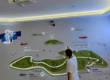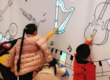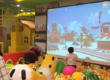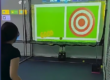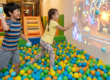

Interactive magic walls and floor projection systems are becoming popular attractions in science museums, children’s entertainment centers, shopping malls, and immersive exhibitions.
Instead of watching a static display, visitors can touch animated characters on a wall, step into virtual water, or activate educational content through movement.
But how can exhibition designers combine wall and floor interactions into one engaging experience?
This guide explains how CPJROBOT PoE LiDAR sensors support multi-touch magic walls, interactive floor projection, and customized exhibition installations.
1. What Is an Interactive Magic Wall?
An interactive magic wall combines projection technology, position-detection sensors, and interactive software to transform an ordinary wall into a responsive digital surface.
For example, a science museum can project an underwater scene featuring fish, coral reefs, and marine animals.
When children touch a projected animal, the interactive software can trigger an animation, sound effect, or educational explanation.
The system typically includes:
- A projector or compatible display
- A LiDAR interactive sensor
- A computer running interactive software
- Calibration and coordinate-mapping tools
- Animated content and audio equipment
The LiDAR detects interaction positions, while the application determines what happens when visitors interact with different objects.
Why Use PoE LiDAR for a Magic Wall?
Unlike a conventional infrared touch frame, a 2D LiDAR sensor does not require a physical frame surrounding the projected image.
This can provide more flexibility for large exhibition walls and custom visual installations.
CPJROBOT PoE LiDAR solutions offer multi-point detection, Ethernet communication, and software integration options for interactive projection projects.
2. How Does LiDAR Interactive Floor Projection Work?
Interactive floor projection allows visitors to activate digital effects by stepping into designated areas.
Popular experiences include:
- Virtual ocean waves and water ripples
- Interactive fish ponds
- Digital flower gardens
- Educational floor games
- Footstep-triggered particle effects
A LiDAR sensor scans a defined plane near the floor.
When a foot or another detectable object intersects the scanning plane, the software calculates its position and sends an interaction event to the application.
The projected content then responds according to the programmed rules.
Important: A standard 2D LiDAR sensor detects positions within its scanning plane. It does not automatically identify individual people, distinguish left and right feet, or perform full-body skeletal tracking.
Applications requiring persistent user identity or detailed body tracking may need additional algorithms or sensing technologies.
3. Combining Interactive Walls and Floors in One Exhibition
A combined wall-and-floor installation can create a more immersive experience than either surface alone.
Consider a marine science exhibition.
Zone A: Interactive Ocean Magic Wall
Visitors touch projected sea animals to activate animations and educational information.
The wall may include several independent interaction areas, allowing multiple children to participate.
Zone B: Interactive Ocean Floor
The floor displays moving water, coral patterns, and virtual marine creatures.
When visitors step into the projected area, ripples or animations appear around their detected positions.
Zone C: Connected Storytelling
The exhibition software can link events between the wall and floor.
For example, touching a projected sea turtle on the wall could activate a related ocean animation on the floor.
This requires shared application logic and coordinated content, not simply connecting two sensors.
Recommended System Architecture
A combined installation may use:
- One or more CPJROBOT PoE LiDAR sensors for wall interaction
- Separate LiDAR coverage for floor interaction
- Wall and floor projectors
- A computer or media-server system
- Compatible calibration and interaction software
- Shared event logic for synchronized effects
Sensor quantity depends on the actual installation dimensions, scanning geometry, and expected number of participants.
4. CPJROBOT F1 PoE LiDAR for Interactive Projection
CPJROBOT develops and manufactures interactive LiDAR sensors for digital exhibition applications.
The F1 PoE LiDAR offers several useful integration features.
| Feature | F1 PoE LiDAR |
|---|---|
| Scanning angle | 270° |
| Scan rate | Up to 30 FPS |
| Power and data | IEEE 802.3af PoE and Ethernet |
| Protection rating | IP65 |
| Interaction | Multi-point detection support |
| Software integration | Unity, TouchDesigner, TUIO and supported SDK interfaces |
| Expansion | Compatible multi-LiDAR configurations |
Confirm current model specifications and software compatibility before procurement.
Simplified Cabling
Power over Ethernet allows compatible sensors to receive power and transmit data through one Ethernet cable.
This can simplify cable management in exhibition halls where sensors are mounted above or beside the interactive surface.
Multi-Touch Experiences
Compatible multi-point detection enables applications to process interactions at different positions.
However, the number of reliable simultaneous interactions depends on sensor placement, object separation, occlusion, and software configuration.
Flexible Content Development
CPJROBOT supports integration workflows involving Unity, TouchDesigner, and TUIO.
This enables developers to create customized animation, sound, educational content, and interactive games.
5. Practical Installation Tips for Exhibition Designers
Check Projection Brightness
Shopping malls and public exhibition halls may have substantial ambient lighting.
Select projector brightness according to the installation area, surface material, and operating environment.
Plan Sensor Mounting
The LiDAR scanning plane must intersect the intended interaction region.
Wall and floor installations require different mounting geometries.
Avoid placing structural objects where they block the sensing area.
Calibrate Touch Coordinates
Calibration maps the physical detection positions to the projected content.
Test the corners, edges, center, and frequently used interaction zones.
Test Multiple Visitors
A successful single-user demonstration does not guarantee reliable multi-user performance.
Test the system with the expected visitor density before handover.
Consider Outdoor Conditions
Outdoor interactive projection requires additional planning for ambient light, weather protection, electrical safety, and projector visibility.
An IP-rated LiDAR sensor alone does not make the complete projection system suitable for outdoor use.
6. Where Can Interactive Magic Walls and Floors Be Installed?
Science Museums: Interactive educational walls and floor-based discovery experiences.
Children’s Playgrounds: Magic walls, virtual oceans, and multiplayer projection games.
Shopping Malls: Seasonal attractions and visitor engagement installations.
Corporate Showrooms: Interactive product presentations and branded experiences.
Hotels and Entertainment Venues: Responsive floor effects and decorative digital installations.
Each application can be customized according to the venue, interaction concept, and available space.
7. Frequently Asked Questions
Can one LiDAR sensor detect both wall and floor interactions?
A single 2D sensor normally scans one defined plane. Separate wall and floor interaction areas generally require different sensing arrangements or additional sensors.
Can multiple children interact with a magic wall simultaneously?
Yes, when the sensor configuration and interactive software support multi-point detection. Performance should be validated with the expected number of users.
Can CPJROBOT PoE LiDAR work with TouchDesigner?
CPJROBOT offers compatible integration options for TouchDesigner, Unity, TUIO, and supported development interfaces.
Can interactive projection content be customized?
Yes. Interactive content can be developed for educational themes, entertainment games, corporate presentations, and branded experiences.
Conclusion
Interactive magic walls and floor projection systems create engaging environments by combining LiDAR sensing, visual content, and real-time interaction.
For exhibition designers, the most important considerations are sensing coverage, calibration, content development, and the visitor experience.
CPJROBOT PoE LiDAR solutions provide a flexible sensing foundation for customized interactive projection projects.
Build Your Interactive Magic Wall with CPJROBOT
Looking for an interactive LiDAR manufacturer for your museum, playground, or exhibition project?
CPJROBOT provides PoE LiDAR sensing solutions, software integration resources, and technical support for customized interactive installations.
Contact CPJROBOT for project consultation:
Email: [email protected]