
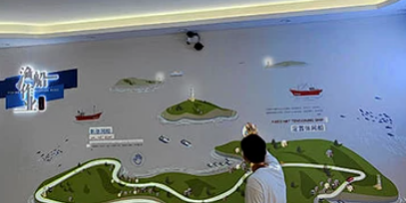
Choosing the right interactive touch technology is an important decision when designing a digital exhibition hall, museum magic wall, or immersive projection environment.
For exhibition system integrators, three common options are LiDAR interactive sensors, infrared (IR) touch frames, and nano touch film.
All three technologies can support interactive experiences, but they differ significantly in sensing principles, installation requirements, surface compatibility, and scalability.
Is LiDAR better than infrared for large interactive walls? Can a LiDAR sensor replace a traditional touch frame? Which solution is more suitable for interactive projection and LED video walls?
This guide compares these technologies from an engineering and procurement perspective and explains how CPJROBOT PoE LiDAR solutions can support modern exhibition projects.
1. Understanding the Three Interactive Touch Technologies
Before comparing performance, it is important to understand how each technology detects interaction.
1.1 LiDAR Interactive Touch Technology
LiDAR (Light Detection and Ranging) measures the distance between a sensor and objects using laser-based sensing.
In a 2D LiDAR interactive projection system, the sensor scans a defined plane near a wall, floor, or other interaction surface.
When a visitor’s hand or another detectable object enters the scanning plane, the software calculates its position and converts it into an interaction event.
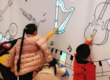
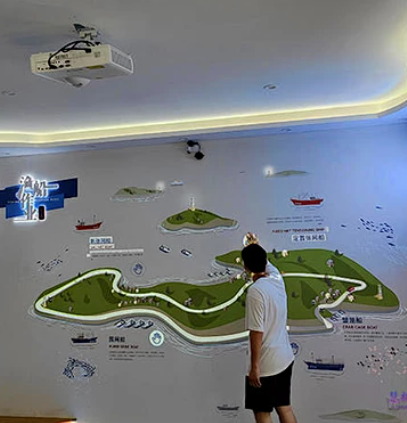
For example, when a child touches a projected animal on a museum magic wall, the application can trigger movement, animation, or sound effects.
Key characteristics:
- Position-based detection within a scanning plane
- No conventional touch frame required around the display
- Supports near-surface or contactless triggering
- Suitable for large interactive walls and floor installations
- Can support multiple interaction points
- Requires appropriate sensor placement and calibration
LiDAR measures positions rather than recognizing visual content. Animation, sound, and game logic are handled by the connected interactive software.
1.2 Infrared Touch Frame Technology
An infrared touch frame typically uses infrared emitters and receivers positioned around the edges of a display.
These components create an optical sensing grid across the interactive area.
When a finger or object interrupts the infrared beams, the controller calculates the touch position.
Infrared touch frames are widely used in interactive whiteboards, information kiosks, and commercial displays.
Key characteristics:
- Established technology for rectangular touch surfaces
- Direct touch-coordinate output on compatible systems
- Multi-touch support on suitable models
- Requires a physical frame or perimeter sensing structure
- Frame size and installation geometry affect scalability
- Performance depends on optical design and environmental conditions
Infrared touch frames can be effective and accurate for fixed display applications.
However, creating a very large or irregular interactive surface may require more complex mechanical integration.
1.3 Nano Touch Film Technology
Nano touch film generally refers to a transparent, film-based touch sensing solution that can be applied to suitable glass or other compatible surfaces.
Depending on the product, the sensing principle may involve capacitive technology or another electrical touch-detection method.
It is commonly considered for interactive shop windows, glass displays, and retail information panels.
Key characteristics:
- Can create touch-sensitive glass installations
- Offers a discreet appearance
- Suitable for compatible transparent surfaces
- Requires appropriate substrate and controller integration
- Installation size depends on the specific product
- Not inherently designed for detecting movement across an open floor
For projects requiring actual touch interaction through glass, nano touch film may be more appropriate than a scanning LiDAR sensor.
2. LiDAR vs Infrared vs Nano Touch Film: Performance Comparison
The following table summarizes the main engineering considerations.
| Feature | 2D LiDAR | IR Touch Frame | Nano Touch Film |
|---|---|---|---|
| Detection principle | Laser distance measurement | IR beam interruption | Film-based touch sensing |
| Physical display frame | Not required | Usually required | Not required |
| Large projection walls | Strong candidate | Depends on frame size | Depends on surface and film |
| Interactive floors | Suitable with correct geometry | Less conventional | Generally unsuitable |
| Irregular surfaces | Possible with planning | Often constrained | Depends on substrate |
| Multi-touch | Software and model dependent | Model dependent | Model dependent |
| Contactless triggering | Yes, within scan plane | Possible near sensing plane | Generally touch/proximity based |
| Ambient light considerations | Optical interference possible | IR interference possible | Depends on sensing design |
| Installation | Sensor mounting and calibration | Frame mounting and alignment | Film application and controller |
| Maintenance | Sensor and optical path | Frame and optical components | Film, wiring and controller |
Important: This comparison describes typical technology characteristics, not laboratory performance rankings. Accuracy, latency, reliability, and total cost must be evaluated using specific products and real installation conditions.
3. Why Consider LiDAR for Large Interactive Projection Walls?
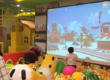
Large interactive walls are increasingly used in science museums, corporate showrooms, children’s entertainment centers, and immersive exhibitions.
These installations often require touch interaction across surfaces much larger than a conventional commercial touchscreen.
3.1 No Physical Touch Frame Around the Wall
A major advantage of LiDAR is that it does not require an infrared frame around the perimeter of the projected image.
This can simplify architectural integration, especially when the exhibition wall is designed as a continuous visual surface.
For example, a large museum projection wall may include multiple visual scenes without visible touch-frame borders.
A suitably positioned LiDAR sensor can detect interactions within its configured sensing area.
This provides more flexibility for exhibition designers.
3.2 Flexible Interaction Zones
LiDAR sensors can be used to define interaction zones within their scanning coverage.
Depending on the software configuration, different positions can trigger different effects.
For example:
- Touch a projected butterfly to activate an animation.
- Select a historical object to display educational information.
- Step into a floor zone to create virtual water ripples.
- Interact with a product image to reveal technical specifications.
These applications are particularly useful when a project requires custom interactive content rather than a standard touchscreen interface.
3.3 Multi-User Interaction
Public exhibition spaces often attract several visitors simultaneously.
Compatible LiDAR interactive systems can detect multiple objects or touch positions within the sensing plane.
For example, several children may interact with different projected elements on the same magic wall.
However, the number of usable simultaneous interactions depends on sensor resolution, object separation, occlusion, software processing, and the application itself.
Multi-touch performance should be tested under the expected visitor density.
3.4 Scalable Coverage for Large Installations
Large walls may exceed the practical sensing coverage of a single device.
Multi-LiDAR configurations can extend detection coverage by combining multiple sensing regions.
For successful integration, system developers must consider coordinate alignment, overlapping detection areas, blind spots, and duplicate events.
CPJROBOT supports compatible multi-LiDAR integration configurations for large interactive projection projects.
4. LiDAR vs Infrared: Which Technology Is More Stable?
Stability is one of the most important concerns for exhibition equipment buyers.
A sensor that works during a short demonstration may behave differently during continuous operation in a crowded public venue.
4.1 Ambient Lighting
Camera-based visual tracking can be affected by changes in illumination, shadows, and background appearance.
Infrared touch frames use optical beams, and certain systems may be affected by strong ambient infrared radiation or interference.
LiDAR uses active optical distance measurement and does not require conventional RGB image recognition.
This can be advantageous for position-based interaction under changing visible lighting.
However, LiDAR is not immune to sunlight, reflective surfaces, or optical interference.
The selected sensor should be tested under actual lighting conditions.
4.2 Occlusion and Blind Spots
Both infrared touch frames and LiDAR sensors can experience detection problems when objects obstruct their sensing paths.
For LiDAR, an object closer to the sensor may block another object behind it within the same scanning plane.
For infrared touch frames, beam obstruction and closely spaced simultaneous touches can affect detection, depending on the controller design.
Proper sensor placement and software configuration are essential for both technologies.
4.3 Touch Accuracy and Response Time
It is not technically correct to assume that LiDAR is always more accurate or faster than infrared touch technology.
A high-quality infrared touch frame may provide excellent performance for a fixed, flat display.
LiDAR can offer greater installation flexibility for large projection surfaces, but accuracy depends on scanning geometry, target size, distance, calibration, and processing.
For procurement, request performance testing at the actual installation dimensions.
The most important measurements include:
- Touch-position error
- End-to-end interaction latency
- Missed detection rate
- False activation rate
- Multi-user detection stability
- Performance across the entire interaction area
5. Best Interactive Sensor for Different Exhibition Applications
Different exhibition scenarios require different sensing capabilities.
5.1 Museum Magic Walls and Interactive Projection Walls
Recommended starting point: 2D LiDAR interactive sensor
A museum magic wall transforms static projected graphics into interactive animations.
Visitors can touch projected animals, characters, historical objects, or educational diagrams to trigger digital responses.
LiDAR is worth evaluating because it can provide position-based interaction without installing a physical touch frame around the entire projection.
For example, CPJROBOT PoE LiDAR can be integrated with interactive content software to create touch-responsive wall installations.
Infrared frames remain suitable alternatives when the project uses a fixed rectangular display and requires conventional touchscreen behavior.
5.2 Interactive Floor Projection
Recommended starting point: LiDAR, with depth sensing evaluated where needed
Interactive floors are commonly used in children’s playgrounds, shopping malls, science museums, and immersive entertainment spaces.
Visitors can step on projected objects to activate water ripples, particles, virtual animals, or game effects.
A LiDAR sensor positioned for the intended floor interaction can detect objects crossing its scanning plane.
This approach can support position-based floor games without requiring a touch-sensitive floor covering.
However, if the application needs full-body tracking, overhead silhouettes, or detailed movement recognition, a depth camera may be more suitable.
5.3 Large LED Video Walls
Recommended starting point: LiDAR for suitable position-based interaction
Large LED video walls are increasingly used in corporate exhibition halls and immersive digital installations.
Unlike conventional touch displays, large LED walls may not have an integrated touch interface.
A LiDAR-based system can provide an external sensing layer for compatible interactive applications.
The sensor detects interaction positions near the display, while the software maps those positions to the LED content.
This may be useful for:
- Interactive product presentations
- Digital brand experience walls
- Museum information displays
- Large-format educational installations
However, LED wall structures, protective surfaces, mounting positions, and the required touch precision must be considered.
If the project requires fine handwriting or precise touchscreen-style input, a purpose-built touch display may be more appropriate.
5.4 Interactive Glass Displays
Recommended starting point: Nano touch film or compatible capacitive touch technology
For retail windows or glass information panels, transparent touch film may be a practical option.
It can provide touch interaction while preserving the appearance of the glass.
LiDAR may be considered if the project requires spatial interaction near the glass rather than direct surface touch.
The choice depends on whether the application needs true contact detection, proximity triggering, or wider spatial sensing.
5.5 Immersive Corridors and Irregular Exhibition Spaces
Recommended starting point: LiDAR for defined spatial interaction zones
Immersive corridors often combine projections across walls and floors.
A conventional rectangular touch frame may be difficult to integrate across irregular architectural surfaces.
LiDAR sensors can be arranged to cover selected interaction regions, provided that each sensing plane is correctly positioned.
For larger projects, multiple sensors may be necessary.
The final configuration should be determined through site drawings, coverage calculations, and testing.
6. CPJROBOT F1 PoE LiDAR: Designed for Interactive Projection Integration
CPJROBOT specializes in the manufacturing and development of interactive LiDAR sensors for digital exhibition and immersive projection applications.
The CPJROBOT F1 PoE LiDAR is designed for interactive wall, floor, and customized spatial sensing projects.
Key Product Features
| Specification | CPJROBOT F1 PoE LiDAR |
|---|---|
| Scanning angle | 270° |
| Scan rate | Up to 30 FPS |
| Power supply | IEEE 802.3af PoE |
| Data communication | Ethernet |
| Cable distance | Up to 100 m under suitable network conditions |
| Protection rating | IP65 |
| Interaction | Multi-point detection support |
| Integration | Unity, TouchDesigner, TUIO and supported SDK interfaces |
| Multi-sensor setup | Compatible multi-LiDAR configurations |
Confirm current model specifications, available detection ranges, and software compatibility before final equipment selection.
6.1 Simplified Cabling with PoE
The F1 PoE LiDAR uses Power over Ethernet technology.
Power and data communication can be provided through a single compatible Ethernet cable.
For exhibition installations, this can simplify cable routing and reduce the need for separate local power connections.
This is particularly useful when sensors are installed on structural frames, near ceilings, or in locations where cable management matters.
6.2 Interactive Software Integration
CPJROBOT provides software integration options for interactive content development.
Supported interfaces and tools can include:
- LiDAR Touch calibration software
- TUIO touch-coordinate communication
- Unity integration
- TouchDesigner integration
- Supported SDK development interfaces
These options help developers connect LiDAR sensing data with custom visual applications.
6.3 Multi-LiDAR Support
For large interactive walls, compatible multi-LiDAR configurations can expand sensing coverage.
System integrators can plan multiple sensing regions and align their coordinates through the appropriate software architecture.
Proper calibration and event processing are required to maintain continuous interaction across sensor boundaries.
7. How to Choose the Right Interactive Touch Sensor for Your Project
Before selecting equipment, exhibition designers and procurement teams should define the project requirements.
Step 1: Confirm the Interactive Surface
Is the installation a projection wall, LED display, interactive floor, glass panel, or irregular architectural surface?
Different surfaces require different sensing arrangements.
Step 2: Define the Interaction Method
Does the application require:
- Physical touch?
- Near-surface triggering?
- Multi-point interaction?
- Position-based movement detection?
- Full-body gesture recognition?
A 2D LiDAR is suitable for certain position-based tasks but does not automatically provide full-body gesture recognition.
Step 3: Measure the Installation Area
Provide the width, height, and shape of the intended interactive region.
Also identify available sensor mounting positions and possible obstructions.
For large installations, evaluate whether one sensor provides sufficient coverage or whether a multi-sensor design is required.
Step 4: Evaluate Environmental Conditions
Consider ambient light, reflective materials, visitor traffic, dust, and maintenance access.
Request a demonstration under representative operating conditions whenever possible.
Step 5: Compare Total Project Cost
Equipment price is only one part of the project budget.
A useful comparison should include:
- Sensor and controller cost
- Mounting hardware
- Cabling and power infrastructure
- Calibration and software integration
- Installation labor
- Maintenance requirements
- Future expansion costs
For a fixed touchscreen, an infrared frame may offer a straightforward solution.
For a large custom projection wall, LiDAR may reduce the need for a display-sized touch frame while introducing its own calibration and integration requirements.
The best choice is the system that meets the project’s functional and operational requirements at an acceptable total cost.
8. Frequently Asked Questions
Q1: Is LiDAR better than infrared for interactive walls?
LiDAR can be a better fit for large projection surfaces, irregular installations, and position-based interaction without a physical display frame. Infrared touch frames can be more straightforward for fixed rectangular screens. The choice depends on installation geometry, accuracy requirements, and budget.
Q2: Can LiDAR replace an infrared touch frame?
Yes, in some interactive wall applications. LiDAR can provide touch-like coordinate input when the sensing plane and software are properly configured. However, it is not a universal replacement for conventional touchscreen technology, particularly for fine writing or precise contact detection.
Q3: What is the best sensor for a large interactive projection wall?
A 2D LiDAR sensor is a strong candidate for large interactive projection walls that require position-based interaction. The final selection should consider sensing coverage, touch accuracy, occlusion, software compatibility, and the number of simultaneous users.
Q4: Can LiDAR work with LED video walls?
Yes. LiDAR can be integrated as an external sensing system for suitable LED video wall applications. Calibration software maps detected positions to the displayed content. Actual performance depends on the display geometry and installation conditions.
Q5: What is the difference between LiDAR and nano touch film?
LiDAR measures object positions using laser-based distance sensing. Nano touch film creates a touch-sensitive region on a compatible surface, commonly glass. LiDAR is often considered for spatial interaction, while touch film is generally used for direct surface interaction.
Q6: Does LiDAR interactive projection work in bright environments?
LiDAR does not require conventional visible-image recognition, which can help in environments with changing visible lighting. However, strong sunlight and optical interference can still affect performance. Testing under actual lighting conditions is recommended.
Q7: Can CPJROBOT PoE LiDAR support multiple users?
Compatible CPJROBOT LiDAR configurations support multi-point detection. The number of reliable simultaneous interactions depends on sensor coverage, object separation, occlusion, and application software.
Q8: Is LiDAR interactive projection easy to install?
PoE connectivity can simplify power and network cabling. However, installation still requires suitable mounting, scanning-plane alignment, coordinate calibration, and software configuration.
Conclusion: Choosing the Right Technology for Interactive Exhibitions
LiDAR, infrared touch frames, and nano touch film each have advantages for different interactive applications.
Infrared touch frames remain practical for conventional rectangular touch displays.
Nano touch film can be suitable for compatible glass-based installations.
LiDAR is particularly worth considering for large interactive projection walls, interactive floors, immersive corridors, and custom exhibition environments that require flexible position-based sensing.
For system integrators, the key is to evaluate sensing coverage, accuracy, installation constraints, software integration, and long-term operating requirements before selecting equipment.
Looking for an Interactive LiDAR Manufacturer?
CPJROBOT develops and manufactures PoE LiDAR sensors for interactive projection and digital exhibition applications.
Our solutions support:
- Interactive wall projection
- Museum magic walls
- Interactive floor projection
- Large LED display interaction
- Children’s entertainment installations
- Immersive exhibition environments
- Customized multi-LiDAR projects
With PoE connectivity, calibration software resources, and integration options for Unity, TouchDesigner, and TUIO, CPJROBOT helps system integrators develop customized interactive experiences.
Contact CPJROBOT to discuss your interactive wall dimensions, sensing requirements, and project integration needs.