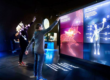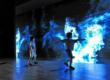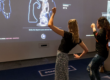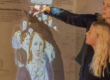

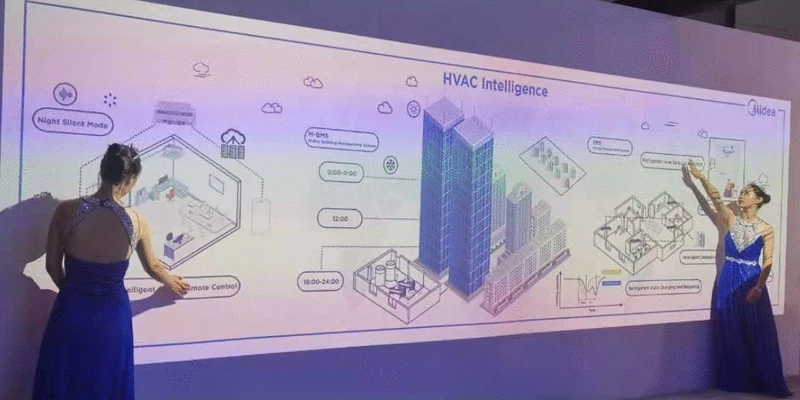
Museums and cultural heritage sites face a fundamental paradox: preserving delicate artifacts requires physical touch restrictions, yet modern museum-goers—accustomed to digital immersion—demand engaging, hands-on experiences. Static display cases and non-interactive wall graphics can no longer fully bridge the gap between ancient history and contemporary audiences.
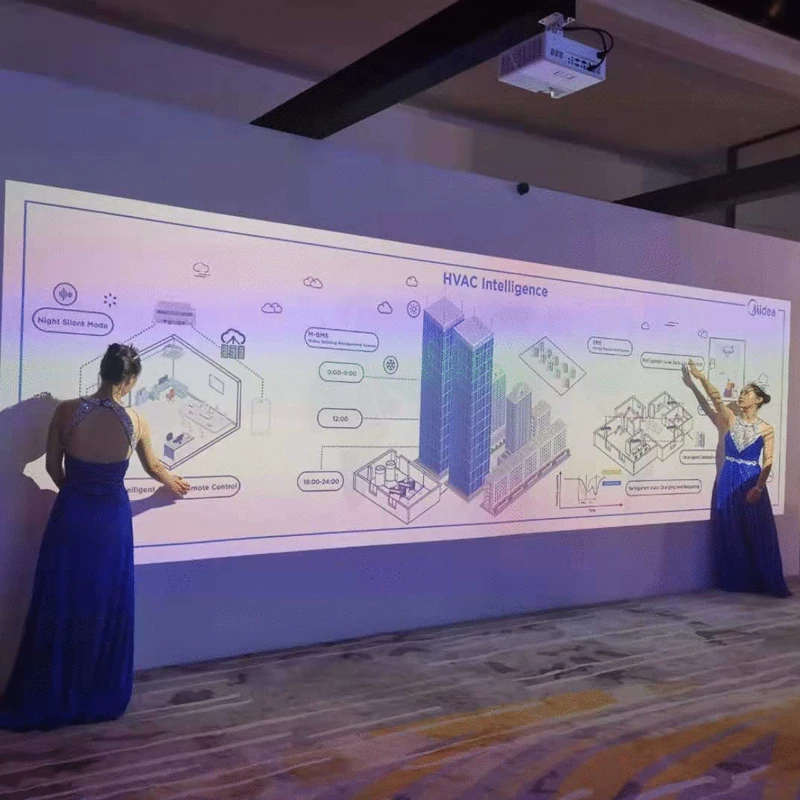
To resolve this conflict, digital exhibition spaces are adopting large-scale interactive wall projections—such as dynamic historical scrolls, interactive ancient murals, and touch-responsive cultural maps.
This article explores how POELIDAR Time-of-Flight (TOF) interactive Lidar sensors, engineered by Shanghai CPJRobot Co., Ltd., empower curators and exhibition designers to transform static historical assets into immersive, multi-touch experiences that allow history to “come alive” with millimetric precision and long-term operational reliability.
The Core Dilemma: Preservation vs. Immersion in Modern Museums
Exhibition design is undergoing a major shift. Visitors no longer wish to passively observe artifacts behind velvet ropes or glass cases; they seek active participation and narrative depth.
However, implementing digital wall interactions across large exhibition spaces introduces significant technical challenges:
- Large Spatial Scale Without Blind Spots: Cultural displays—such as historical panorama scrolls or expansive murals—often stretch across tens of meters. Standard infrared touch frames or camera-based vision tracking struggle with edge dead-zones and alignment drift across large surfaces.
- Dense Multi-Touch Concurrency: School groups, tour parties, and weekend crowds frequently gather at the same mural. Sensing systems must track dozens of simultaneous touch points without dropping connections or misidentifying coordinates.
- Complex Low-Light Environments: Museums rely on low, directional accent lighting to protect physical artifacts and maintain theatrical ambiance. Traditional camera tracking systems frequently fail under inconsistent light conditions or projector high-contrast glare.
- Discreet Integration & Conservation Requirements: Hardware must be hidden from view to maintain historical authenticity, while avoiding invasive mounting that could alter historic structures.
+-----------------------------------------------------------------------------------+
|                        MUSEUM DIGITIZATION CHALLENGES                             |
|                                                                                   |
|  [ Traditional Displays ]                   [ Multi-Touch Interactive Space ]     |
|   - Glass Case Barrier                       - Multi-User Concurrency             |
|   - Passive Reading                          - Low-Light Ambient Stability        |
|   - Physical Touch Restrictions              - Discreet Invisible Mounting        |
|                                              - Zero Frame Drift / High Accuracy   |
+-----------------------------------------------------------------------------------+
Technical Superiority: Why POELIDAR Outperforms Legacy Sensing Systems
Historically, exhibition integrators relied on repurposed industrial Lidars or optical camera setups. These legacy systems introduced frequent calibration errors, awkward mounting requirements, short operational lifespans, and poor software compatibility.
Designed explicitly for high-end exhibition spaces, the POELIDAR series by Shanghai CPJRobot Co., Ltd. delivers an industrial-grade solution tailored to complex museum requirements.
Performance Comparison for Museum Integration
| Technical Parameter | Legacy IR Cameras / Frame Overlays PDF+ 1 | POELIDAR-F1 (Pro Interactive) PDF | POELIDAR-M1 (Compact Series) PDF |
| Sensing Technology | Optical Vision / IR Reflection | TOF (Time-of-Flight) Laser | TOF (Time-of-Flight) Laser |
| Scanning Range | Restricted / Frame-limited | 270° Sweep Angle | 360° Full Angle |
| Practical Detection Radius | Short distance limits | >11m Wall / >13m Floor | >4m Practical (12m Max) |
| Positioning Accuracy | Prone to drift under lighting changes | <2cm (6m Wall) / <3cm (10m Wall) | <3cm (4m Wall) |
| Frame Refresh Rate | 10–15 FPS typical | Up to 30 FPS Real-Time | 10 FPS |
| Multi-Touch Capacity | Restricted touch points | 256 Points (Win) / Unlimited (TUIO) | 256 Points (Win) / Unlimited (TUIO) |
| Wiring & Power Architecture | Dual power/signal runs | IEEE 802.3af POE (1 Cable >100m) | IEEE 802.3af POE (1 Cable >100m) |
| Cascading Capacity | Synchronizing >2 sensors is complex | >20 Sensors Cascaded per Host PC | >20 Sensors Cascaded per Host PC |
Key Application Scenarios in Museums & Cultural Venues
1. Interactive Ancient Scrolls & Digital Long-River Masterpieces
- The Experience: Visitors touch characters, buildings, or riverboats on a 15-meter digitally projected historical scroll. Upon touch, dynamic pop-ups reveal architectural details, audio commentary, and ancient artisan notes.
- POELIDAR Implementation: A single POELIDAR-F1 unit mounted discreetly along the wall baseboard covers up to 20+ meters of wall surface with its 270° scanning arc. The 30 FPS refresh rate and <2cm accuracy ensure touch points map instantly to complex high-resolution graphics without coordinate lag.
2. Restored Mural & Cave Art Projection Mapping
- The Experience: In dark cave-replica halls or ancient wall exhibits, touching specific sections of a faded wall projection restores original colors in real-time, bringing ancient murals to life.
- POELIDAR Implementation: Operating on active Time-of-Flight laser measurement, POELIDAR remains unaffected by low-light exhibition rooms or high-lumen projector glare. It detects sub-centimeter hand touches while staying hidden from sight.
3. Curved & Arc Curtain Immersive Theaters
- The Experience: Visitors interact with large curved projection screens or 360° immersive arc-curtain theaters.
- POELIDAR Implementation: POELIDAR natively supports flat, tri-folded, L-shaped, and curved surfaces. By cascading multiple POELIDAR sensors over a single PC, curatorial teams can create uninterrupted interactive surfaces around complex architectural layouts.
+-----------------------------------------------------------------------------------+
|                        POELIDAR INTERACTIVE ARCHITECTURE                          |
|                                                                                   |
|  [ Laser Radar Array ] --->  [ Single CAT6 Cable (Power + Data) ]                 |
|          |                                   |                                    |
|          v                                   v                                    |
|   270°-360° TOF Scan                 Gigabit POE Switch                           |
|          |                                   |                                    |
|          +-----------------------------------+                                    |
|                                              |                                    |
|                                              v                                    |
|                                 [ Master PC / Interactive Engine ]                |
|                                 (Unity / TouchDesigner / C++)                     |
|                                              |                                    |
|                                              v                                    |
|                              [ Multi-Touch Output to Projectors ]                 |
+-----------------------------------------------------------------------------------+
Simplified Engineering for Exhibition Designers and Integrators
POELIDAR simplifies deployment for AV contractors and museum technical directors through key engineering features:
- Single Ethernet Cable Deployment (POE): Operating under standard IEEE 802.3af POE protocols, both power and data transmit over a single CAT6 network cable for distances exceeding 100 meters, eliminating complex localized electrical installations.
- Seamless Software Compatibility: POELIDAR supports standard TUIO and Windows multi-touch protocols, offering native integration with major creative engines like Unity, Unreal Engine, TouchDesigner, C++, C#, and Processing.
- Automated System Operation: Automated startup and shutdown synchronize with exhibition computer systems, while loop playlist software allows seamless content scheduling without manual intervention.
Conclusion
By bridging physical artifacts with digital interactivity, POELIDAR technology resolves the historical conflict between preservation and engagement. Museum directors and exhibition planners can now transform static display boards into dynamic, multi-sensory storytelling platforms that leave lasting impressions on modern audiences.