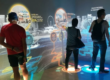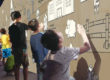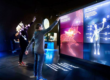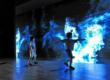

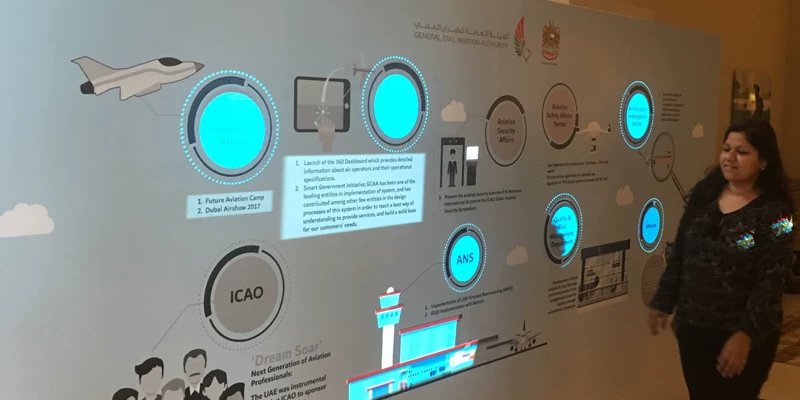
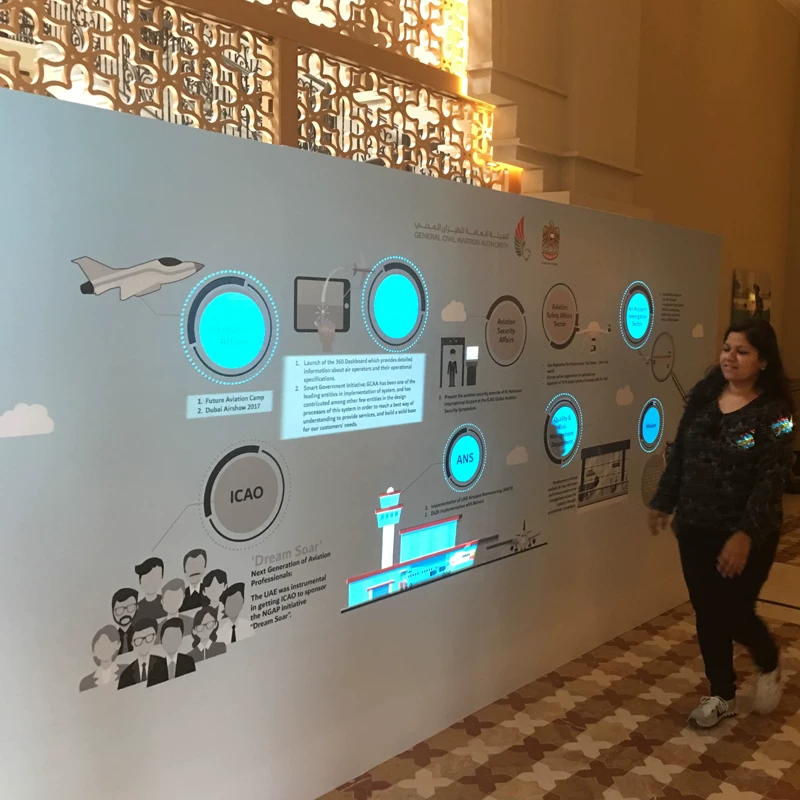
In the modern commercial landscape, brick-and-mortar retail venues face intense competition from e-commerce platforms. To remain relevant, shopping malls, commercial complexes, and retail pop-up stores are shifting away from transactional shopping models toward “experience-first” destinations.
Capturing consumer attention—often referred to as the “Attention Economy”—is no longer just about visual aesthetics; it requires real-time, physical interaction. Experiential features such as interactive wall projections, touch-responsive brand installations, and floor projection games have proven to significantly extend shopper dwell time, boost foot traffic conversions, and generate organic social media sharing.
However, executing large-scale interactive walls in busy commercial environments presents distinct engineering hurdles: strong ambient lighting, glass reflections, high crowd densities, and complex spatial layouts.
This technical guide by Shanghai CPJRobot Co., Ltd. explores how POELIDAR Time-of-Flight (TOF) interactive Lidar sensors overcome commercial venue limitations to deliver high-concurrency, low-cost, and maintenance-free interactive installations.
The Commercial Pain Points: Why Traditional Interactive Wall Solutions Fail in Malls
Shopping malls and pop-up activations are challenging environments for interactive sensor hardware. Venue operators and event planners who deploy legacy camera-vision systems or physical touch frames frequently encounter four major operational pain points:
- Severe Ambient Light & Reflection Interference: Modern commercial centers feature glass skylights, bright LED screens, and high-lumen spotlights. Optical cameras and traditional infrared (IR) framing systems experience severe tracking drift or complete failure under direct glare and ambient light shifts.
- Crowd Congestion & High-Density Concurrency: During weekend traffic spikes, dozens of shoppers—adults and children alike—may interact with a single wall simultaneously. Standard touch sensors drop connection points or crash when handling high concurrency.
- Expensive Installation & Messy Cabling: Running separate power lines and data cables across large atrium walls or high ceilings drastically increases installation labor and creates safety hazards.
- Maintenance & Equipment Damage Risks: Touchscreens or physical overlay frames installed at arm’s reach are vulnerable to accidental impacts, vandalism, and surface wear, leading to high repair costs.
+-----------------------------------------------------------------------------------+
|                       COMMERCIAL VENUE SENSING CHALLENGES                         |
|                                                                                   |
|  [ Traditional Camera / IR Frame ]           [ POELIDAR TOF Solution ]            |
|   - Sunlight & LED Glare Failure              - Active Laser Ranging (Immune)     |
|   - Limited Concurrency Touch Points          - 256 Points (Win) / Unlimited TUIO |
|   - Multi-Cable Messy Cabling                 - Single CAT6 POE Cable (>100m)     |
|   - Exposed Equipment (Vulnerable)            - Hidden Corner Mount (Safe)        |
+-----------------------------------------------------------------------------------+
The POELIDAR Solution: Purpose-Built Sensing for High-Traffic Retail
Unlike industrial Lidars adapted for robotic navigation, POELIDAR was engineered specifically by Shanghai CPJRobot Co., Ltd. to solve spatial interactive sensing in commercial environments.
Technical Architecture Comparison
| Parameter / Capability | Traditional IR / Camera Vision Systems PDF+ 1 | POELIDAR-F1 (Commercial Pro) PDF | POELIDAR-M1 (Portable/Pop-Up) PDF |
| Sensing Principle | Optical Vision / IR Light Reflection | TOF (Time-of-Flight) Laser | TOF (Time-of-Flight) Laser |
| Scanning Sweep | Narrow Restricted Angle | 270° Wide Angle | 360° Full Angle |
| Detection Coverage | Small-to-medium areas | >11m Wall / >13m Ground | >4m Practical (12m Max) |
| Positioning Precision | High drift under light changes | <2cm (6m wall) / <3cm (10m wall) | <3cm (4m wall) |
| Frame Refresh Rate | 10–15 FPS typical | 10 to 30 FPS Real-Time | 10 FPS |
| Multi-Touch Concurrency | Highly restricted | 256 Points (Win) / Unlimited (TUIO) | 256 Points (Win) / Unlimited (TUIO) |
| Power & Data Cabling | Separate AC power + USB/HDMI | Single Cable POE (IEEE 802.3af) | Single Cable POE (IEEE 802.3af) |
| Enclosure Rating | Indoor open frame | IP65 Dustproof & Waterproof | Standard Compact Form Factor |
Commercial Value: How POELIDAR Drives Revenue & Engagement
1. Extends Shopper Dwell Time & Increases Tenant Sales
Studies in retail analytics consistently show a direct correlation between visitor dwell time and total retail spending. A POELIDAR-powered interactive wall turns an empty atrium wall into a dynamic playground or interactive brand experience. By keeping families and shoppers engaged for longer periods, surrounding food and beverage (F&B) tenants and retail storefronts experience higher foot-traffic conversion.
2. Creates Low-Cost, Organic Social Media Marketing (UGC)
Interactive walls running captivating visual effects—such as dynamic flower blooming upon touch, particle streams, or brand-sponsored mini-games—naturally encourage shoppers to capture photos and videos. As shoppers upload these moments to social platforms like Instagram, TikTok, or Xiaohongshu, the venue gains free user-generated content (UGC) and organic viral reach.
3. Rapid Deployment for Pop-Up Stores & Brand Events
For marketing agencies planning short-term brand pop-ups, deployment speed is critical.
- Single CAT6 Cable Setup: POELIDAR utilizes standard Power over Ethernet (POE IEEE 802.3af) to send power and data across a single network cable over 100 meters, drastically lowering setup costs and installation complexity.
- Universal Protocol Support: Native integration with TUIO, Windows Multi-Touch, Unity, Unreal Engine, TouchDesigner, C++, and Processing allows interactive software developers to deploy custom games and visual effects in hours rather than days.
+-----------------------------------------------------------------------------------+
|                        POELIDAR COMMERCIAL DEPLOYMENT                             |
|                                                                                   |
|  [ POELIDAR Sensor ] --->  [ Single CAT6 Ethernet Cable ]                         |
|         |                                    |                                    |
|         v                                    v                                    |
|  270°-360° TOF Scan                 Gigabit POE Switch                            |
|         |                                    |                                    |
|         +------------------------------------+                                    |
|                                              |                                    |
|                                              v                                    |
|                                 [ Commercial PC Engine ]                          |
|                                 (Unity / TouchDesigner)                           |
|                                              |                                    |
|                                              v                                    |
|                              [ Multi-Touch Wall & Floor ]                         |
+-----------------------------------------------------------------------------------+
Real-World Commercial Application Scenarios
Scenario A: Mall Atrium Interactive Photo & Viral Landmark Wall
- Deployment: A single POELIDAR-F1 mounted near the ceiling or wall corner sweeping across a 15-meter wide projection surface.
- User Experience: When passersby walk past or reach out to touch the wall, giant glowing brand elements, particle art, or seasonal themes respond instantly to their movements. Its 30 FPS refresh rate and sub-2cm accuracy ensure zero visual latency, keeping shoppers immersed.
Scenario B: Experiential Retail Pop-Up Stores
- Deployment: The compact, lightweight POELIDAR-M1 (weighing only 125.5g) mounted inside temporary retail booths.
- User Experience: Customers tap projected product displays on flat, curved, or L-shaped surfaces to reveal product specifications, custom color options, and promotional discount codes.
Conclusion
In the era of experiential retail, static marketing displays no longer suffice. By deploying purpose-built Time-of-Flight Lidar sensors, commercial real estate developers, mall marketing directors, and pop-up planners can reliably create high-impact, multi-touch interactive spaces that boost foot traffic, extend shopper dwell times, and maximize return on investment (ROI).