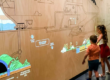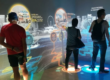

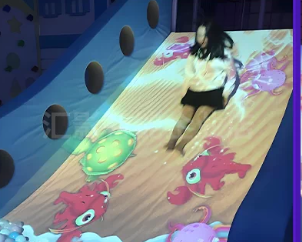
In large-scale Family Entertainment Centers (FECs), traditional single-lane slides are increasingly replaced by wide-span multi-user interactive slides (often ranging from 3 to 6+ meters in width). While these attractions significantly increase venue throughput and maximize social play, they introduce substantial technical complexities. Capturing multiple high-velocity, overlapping human trajectories across a massive surface without dead zones requires advanced telemetry.
To achieve a seamless user experience, venue operators and system integrators must combine multi-projector edge-blending with specialized wide-angle LiDAR tracking systems designed for large-scale spatial computing.
1. Large-Scale Multi-User Interaction Architecture
Unlike standard slides, a wide-span interactive slide must process multiple independent interaction points simultaneously, maintaining high frame rates and precise localization.
[Multiple Kids Sliding Simultaneously]
                  │
                  ▼
   [Wide-Scan CPJROBOT LiDAR Array] ───> [Real-Time Multi-Touch Clustering]
                                                        │
                                                        ▼
[Edge-Blended Visual Climax] <─── [UDP/TUIO Matrix] <─── [Unity/TouchDesigner]
High-Density Multi-Touch Clustering
When multiple children descend at different speeds, paths, and postures, the sensory overlay experiences massive tracking turbulence. The system must cluster raw spatial data into individual player profiles in real time. As children race down, the rendering engine triggers distinct visual paths—such as individual lava bursts, deep-sea vortexes, or exploding starfields—under each child independently.
Co-op and Competitive Game Vectors
Wide slides leverage spatial width to foster group dynamics. Games project giant scrolling targets, moving obstacles, or cascading numeric gold coins across the entire expanse. Children work together to clear screen-wide “monster bosses” or compete for the highest score, with live tracking ranks projected directly onto the scoreboard at the slide’s base.
2. Advanced Hardware Topology for Wide Surface Tracking
Deploying interactive projection across a wide surface dictates a distributed hardware architecture to eliminate tracking blind spots and visual occlusion.
+---------------------------------------------------------------------------------------+

|                                  Main Ceiling Truss                                   |
|  +--------------------------+   +------------------------+   +---------------------+  |
|  |   CPJROBOT Wide-Angle    |   |  Laser Projector A     |   |  Laser Projector B  |  |
|  |   LiDAR (Master Array)   |   |  (Left Channel/UST)    |   |  (Right Channel/UST) |  |
|  +------------+-------------+   +-----------+------------+   +----------+----------+  |
+---------------|-----------------------------|---------------------------|-------------+
                |                                      Edge-Blended Video
                | Low-Latency Raw Coordinates          (Overlapping Canvas)
                v (UDP / TUIO Network)                 ▲
+---------------+--------------------------------------|--------------------------------+

|             Central Media Server (Multi-Channel Graphics + Tracking Engine)           |
+---------------------------------------------------------------------------------------+
Ultra-Wide Tracking Optimization via CPJROBOT
Standard infrared cameras or consumer sensors fail across wide-span surfaces due to geometric distortion and range limitations. Industrial-grade LiDAR sensors from CPJROBOT solve these enterprise constraints:
- Extended Scanning Field: CPJROBOT wide-angle LiDARs deliver expansive scanning fields, allowing a single master sensor to cover up to 6+ meters of slide width when positioned at an optimal inclined angle at the slide’s header.
- Multi-Point Touch Fidelity: The sensor network utilizes optimized UDP/TUIO protocols, transmitting multi-touch coordinates to the interactive engine with an industry-leading latency profile of under 30ms. This ensures real-time feedback even at maximum slide capacity.
Multi-Projector Edge-Blending Arrays
A single projector cannot cover a wide slide without massive edge distortion or severe lumen degradation.
- Dual-Projector Overlap: Integrators deploy two or more 5,000+ ANSI Lumen UST projectors side-by-side.
- Edge-Blending Software: Software maps the image across both hardware units, blending the overlapping center pixels to create a uniform, bright, and seamless high-contrast visual canvas.
Substrate and Material Uniformity
Wide slides made of modular sections often contain visible joints or seams.
- Surface Standard: The sliding surface must consist of a seamless, matte-white, or light gray high-density polymer or non-reflective fiberglass.
- LiDAR Safety: Glossy finishes or visible metallic connection bolts must be covered or treated, as they cause infrared light scattering that compromises the integrity of the LiDAR tracking plane.
3. Industrial Safety, Noise Filtering, and Multi-Lane Calibration
Operating wide slides in crowded children’s parks requires robust algorithmic filtering to separate active players from environmental noise.
+---------------------------------------------+---------------------------------------------+

|          Wide-Slide Fail-Safe Logic         |          Operational Risk Mitigation        |
+---------------------------------------------+---------------------------------------------+

| * Multi-Zone Geometric Masking              | * Rigid Anti-Vibration Structural Mounts    |
| * Dynamic Blob-Size Filtering               | * Watchdog Auto-Restart Software Scripts    |
+---------------------------------------------+---------------------------------------------+
Multi-Zone Geometric Masking
On wide slides, spectators, parents, and waiting children frequently lean over the sides or sit on the edge platforms.
- Algorithmic Boundary Isolation: Tracking software must apply strict perimeter masking. The CPJROBOT control interface allows technicians to isolate and track only the active sliding zones, filtering out peripheral interruptions from handrails, safety padding, or rogue balls from ball pits.
- Blob-Size Filtering: To prevent tiny objects (like a single stray ball) from triggering massive visual explosions, software algorithms calculate the mass profile (“blob size”) of objects, validating tracking inputs only when they match a child’s structural profile.
Structural Stability and Automated Recovery
Wide trusses are highly prone to structural vibrations caused by hundreds of running children nearby, which can shift projector alignment over time.
- One-Touch Matrix Recalibration: CPJROBOT tracking suites feature rapid grid alignment toolsets. If the physical truss shifts slightly, park staff can restore perfect alignment between the LiDAR scanning plane and the projector grids using a simple, one-touch software function.
Conclusion: Future-Proofing Indoor Play Ecosystems
Scaling up to wide-span interactive slides allows family entertainment centers to maximize operational capacity while delivering high-impact, memorable play experiences. By engineering the attraction with high-lumen blended projection, ultra-matte substrates, and industrial-grade tracking telemetry, park operators can turn passive playground equipment into high-yield, digitally reactive anchor attractions.
Scale Your Attraction with CPJROBOT LiDAR Technology
Are you designing a wide-span interactive slide or a large-scale immersion park? As a premier interactive radar manufacturer, CPJROBOT delivers advanced, low-latency LiDAR hardware purpose-built for multi-user commercial play environments.