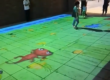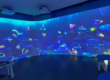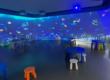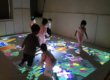


Interactive floor projection systems are increasingly used in shopping malls, retail stores, and public spaces to attract attention, increase dwell time, and create memorable user experiences.
From an engineering and deployment perspective, these systems are not just visual effects—they are real-time sensing + projection + interaction pipelines. The choice of sensing technology, system architecture, and installation method directly determines performance.
This guide explains:
- How interactive floor projection systems work
- Why they are effective in commercial environments
- Key engineering considerations for stable deployment
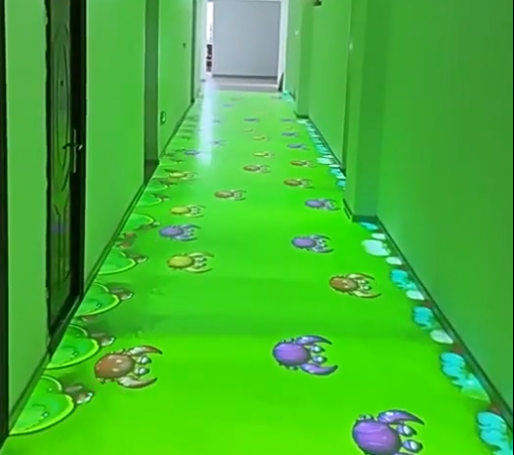
1. What Is an Interactive Floor Projection System?
An interactive floor projection system combines:
- Projection hardware (projector)
- Sensing system (LiDAR / infrared / camera)
- Processing unit (PC or media server)
- Interaction software
When a person steps into the projection area, the system detects movement and triggers real-time visual feedback.
2. How Interactive Floor Systems Work (System Architecture)
Core Workflow:
- Projection Mapping
- Projector displays content onto the floor
- Sensing Detection
- Sensor detects foot movement or presence
- Data Processing
- Coordinates are mapped to the projection area
- Interaction Trigger
- Content responds instantly (e.g., ripple, explosion, animation)
Engineering Insight:
In commercial deployments, LiDAR-based systems (TOF) are increasingly preferred because they provide:
- Stable detection over large areas
- Accurate multi-point tracking
- Resistance to ambient light
Manufacturers like CPJROBOT focus on PoE LiDAR solutions to simplify installation and improve reliability.
3. Why Interactive Floor Projection Works in Commercial Spaces
3.1 Foot Traffic Attraction
Interactive floors naturally attract attention because:
- Movement triggers immediate visual feedback
- People are drawn to dynamic content
- It creates a “see → approach → interact” behavior loop
Practical Observation:
- Shoppers often stop when they notice others interacting
- Creates organic crowd gathering zones
3.2 Increased Dwell Time
Once users engage, they tend to stay longer:
- Interactive games and animations encourage repeated interaction
- Children and families spend more time in the area
- Longer dwell time increases conversion probability in retail environments
3.3 Children Engagement
Children are one of the strongest drivers of interaction:
- Responsive floor animations (water, fish, footprints)
- Simple, intuitive interaction (no learning required)
- Parents stay longer → indirect commercial value
4. Key Technologies Behind Floor Interactive Systems
4.1 LiDAR Systems (Recommended)
Advantages:
- High accuracy (centimeter-level)
- Works in bright environments
- Supports large-scale installations
4.2 Infrared Systems
Limitations:
- Sensitive to sunlight
- Requires precise alignment
- Less scalable
4.3 Camera-Based Systems
Limitations:
- Affected by lighting and shadows
- Higher latency
- Complex calibration
Engineering Conclusion:
For shopping mall interactive floor systems, LiDAR provides the best balance of:
- Stability
- Accuracy
- Scalability
5. Installation Considerations (Real-World Deployment)
5.1 Coverage Planning
- Ensure full coverage of interaction area
- Avoid blind zones at edges
5.2 Projector Alignment
- Projection area must match sensing area
- Misalignment leads to inaccurate interaction
5.3 Environmental Control
- Avoid reflective floors (polished tiles)
- Minimize strong direct lighting
5.4 Sensor Positioning
- Mount above interaction area
- Ensure unobstructed detection field
5.5 Calibration
- Multi-point calibration ensures accurate mapping
- Critical for user experience
6. Typical Commercial Use Cases
Shopping Malls
- Entrance attraction zones
- Kids play areas
- Promotional campaigns
Retail Stores
- Brand engagement floors
- Product launch experiences
Exhibitions & Events
- Interactive walkways
- Immersive storytelling
Public Spaces
- Airports
- Museums
- Entertainment centers
7. ROI Perspective (Engineering + Business)
Interactive floor systems provide measurable value:
- Increased foot traffic
- Longer dwell time
- Higher engagement rate
- Improved brand recall
From a system design perspective, the key is stability over time, not just initial effect.
8. Why PoE LiDAR Systems Improve Deployment Efficiency
Modern systems from CPJROBOT use PoE (Power over Ethernet):
- Single cable for power + data
- Reduced wiring complexity
- Faster installation
- Easier maintenance
This is particularly important in large commercial projects where installation time impacts cost.
9. FAQ (Frequently Asked Questions)
Q1: What is an interactive floor projection system used for?
It is used to create real-time interactive experiences in commercial and public spaces, improving engagement and foot traffic.
Q2: What is the best technology for interactive floors?
For large commercial environments, LiDAR-based systems offer the best stability and accuracy.
Q3: Does lighting affect performance?
Yes. Infrared and camera systems are affected by light, while LiDAR is more resistant.
Q4: Is installation complicated?
Modern PoE LiDAR systems significantly reduce complexity, making installation faster and more reliable.
Q5: Can multiple users interact at the same time?
Yes. LiDAR systems support multi-user interaction without performance loss.
An interactive floor projection system is not just a visual feature—it is a real-time sensing system integrated with spatial mapping and content interaction.
Choosing the right sensing technology determines whether the system will:
- Perform reliably under real-world conditions
- Scale to large environments
- Deliver consistent user experience
For most commercial applications, LiDAR-based systems are currently the most robust solution.
If you are planning a shopping mall interactive floor or a commercial interactive space, system design should start from sensing technology selection and deployment architecture.
CPJROBOT provides PoE LiDAR-based interactive solutions designed for real-world commercial environments.