
Interactive floors and walls have moved from novelty to expected feature in a short window of time. Science museums, brand experience centers, hotel lobbies, and retail flagship stores are all operating interactive installations today. The question for venue owners and operators is no longer whether to invest in interactive technology — it is how to choose a system that works reliably for years, not just for the opening weekend.
This guide focuses on multi-LiDAR cascade systems, using CPJROBOT’s POELIDAR-F1 as the reference product. We cover the practical questions that matter at the procurement and operations stage.
Why the Sensor Technology Choice Has Long-Term Consequences
Interactive installations that depend on consumer-grade hardware — tablet cameras, short-range IR sensors, depth cameras designed for gaming — tend to work well in controlled demos and degrade in real-world operation. The failure modes vary: camera-based systems drift under changing ambient light; IR grids collect dust on their emitter bars; consumer depth sensors are not rated for continuous commercial operation.
For a venue running 8 to 12 hours a day, 300+ days a year, these degradation patterns matter. The POELIDAR-F1 draws under 5W per unit, is rated for operation between -20°C and 60°C, and carries an IP65 rating. This is the difference between a system your facilities team can leave running unattended and one that needs regular intervention.
Coverage: How Many Units Does Your Space Need?
Working radius: over 11 meters on wall surfaces, over 13 meters on floors. CPJROBOT’s cascade architecture supports up to 20 units managed from a single computer.
| Space type | Typical unit count | Notes |
| Single interactive wall (up to 8m wide) | 1–2 | Depends on height and mounting distance |
| Floor installation (up to 15×15m) | 2–4 | Corner or edge mounting |
| 360° interactive room (up to 10m diameter) | 4–6 | Ceiling-mounted, angled inward |
| Corridor or L-shaped gallery | 2–4 | Segmented zone assignment |
| Dome or curved ceiling | 4–8 | Requires precise angular calibration |
| Full immersive suite (mixed surfaces) | 8–16 | Multiple zones, overlapping coverage |
All units in a cascade share one IP network and one host computer. No secondary control hardware required — no middleware server, no additional license fees per sensor.
Operating Costs: What Actually Drives Them
Energy: POELIDAR-F1 consumes under 5W per unit. A 10-unit installation draws under 50W from the sensor layer alone — less than a standard office monitor. Annual energy cost for the sensor array is negligible.
Maintenance: There are no consumable parts in the POELIDAR-F1. No lamps to replace, no filters to clean, no calibration targets to replace. Standard maintenance is an occasional network check and a periodic software update from CPJROBOT.
Content management: CPJROBOT’s built-in playlist manager allows venue operators to schedule different interactive programs to run at different times, or to loop a program list automatically. This reduces the staff time needed for day-to-day content management significantly.
Installation: What to Expect From the Process
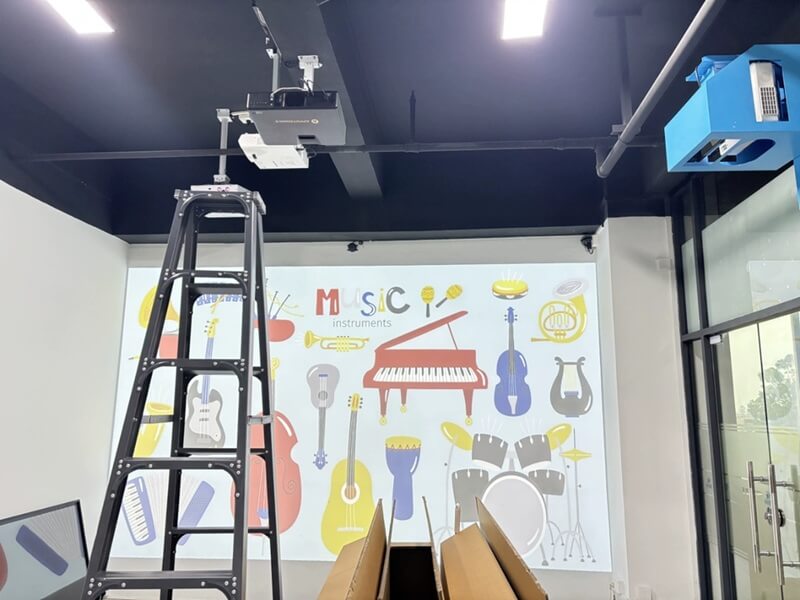
POELIDAR-F1 units connect over standard CAT6 Ethernet with POE power delivery. No dedicated power cabling run to each sensor location, no high-voltage electrical work required at sensor mounting points. Sensors can be repositioned by moving the cable connection and updating the zone calibration in software.
The 100-meter cable run limit per unit is sufficient for most venue layouts. Calibration time per unit is typically 30 to 60 minutes for an experienced installer. A 10-unit installation typically takes one to two days to fully commission, including content integration testing.
Questions to Ask Any LiDAR Interactive Vendor
Regardless of which system you are evaluating, these questions distinguish between products built for professional venue operation and those adapted from other use cases:
- What is the rated continuous operating life of the sensor? Professional interactive LiDAR should have a defined MTBF or a stated commercial operating life.
- How is touch accuracy specified — and at what distance? A vendor claiming ‘2cm accuracy’ without specifying the measurement distance is quoting best-case numbers. The POELIDAR-F1 specifies typical accuracy at both 6m and 10m.
- What happens to the installation if the host computer crashes and restarts? CPJROBOT’s system is designed to automatically reconnect sensors and resume operation on restart, with no manual reconfiguration.
- What protocols does the system output? TUIO and Windows multi-touch are the two standards used by most interactive content platforms. Proprietary output protocols create long-term lock-in risks.
- What does the warranty cover, and what is the support response time?
Making the Decision
Multi-LiDAR cascade is not the right choice for every interactive installation. For small, single-surface, well-bounded spaces with controlled lighting, simpler technologies may be more cost-effective. But for any installation that needs to cover more than one surface, more than 15 square meters, or a non-rectangular geometry, cascade LiDAR is one of the most reliable and maintainable options available.
CPJROBOT’s POELIDAR-F1 is worth a close look specifically because it was designed for the interactive industry — not adapted from a robot navigation sensor. That design focus shows up in the parameter set, the software architecture, and the support infrastructure.
For venue specification or procurement inquiries, contact CPJROBOT at [email protected] or +86 21 51769038. Technical documentation and deployment case studies are available on request.
CPJROBOT (Shanghai CPJRobot Co., Ltd.) develops interactive LiDAR systems for professional venue and experiential installation use. Products are designed and manufactured in Shanghai, with installations across retail, cultural, educational, and entertainment sectors.