
Designing large-scale interactive projection walls—such as immersive exhibition spaces, museum panorama displays, corporate data walls, and commercial atrium installations—requires choosing the right spatial touch-sensing technology.
For years, systems integrators and AV engineers relied on optical infrared (IR) cameras or physical IR touch frame overlays. However, as project scales expand to curved walls, L-shaped surfaces, and high-concurrency environments, legacy optical technologies exhibit severe technical limitations: ambient light interference, edge-detection dead zones, complex multi-camera calibration, and mounting fragility.
This white paper by Shanghai CPJRobot Co., Ltd.—the original manufacturer of the PoeLidar series—provides an engineering comparison between IR Cameras, IR Touch Frames, and Purpose-Built Interactive TOF Lidar (POELIDAR-F1 and POELIDAR-M1). We evaluate coverage area, environmental lighting immunity, installation complexity, and multi-point touch accuracy to demonstrate why Lidar touch technology offers superior total cost of ownership (TCO) and system reliability.
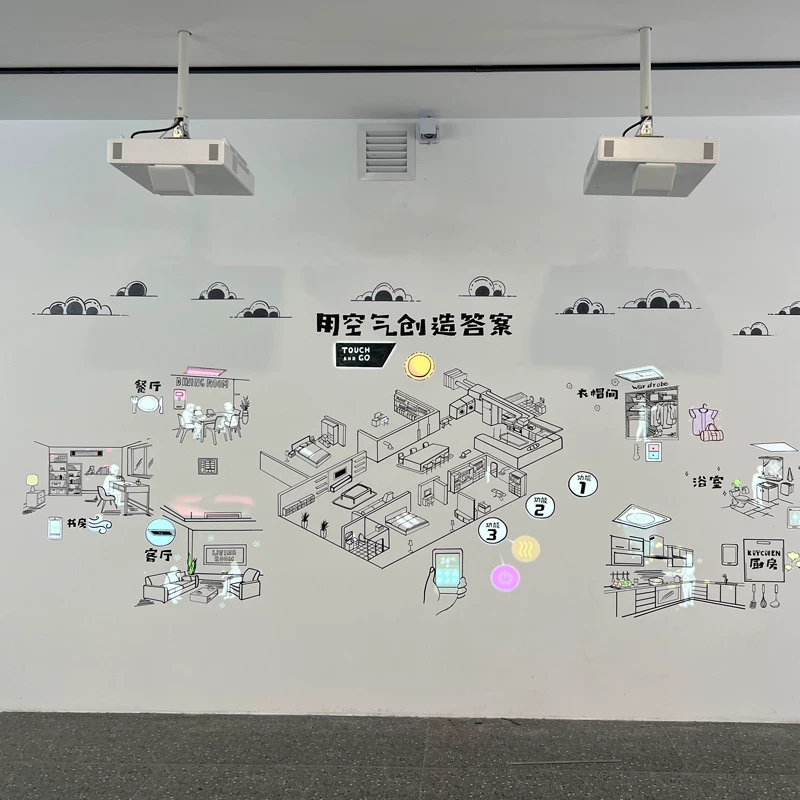
Technical Comparison: Sensing Technologies in Large Interactive Spaces
+-----------------------------------------------------------------------------------+
|                     SENSING ARCHITECTURE COMPARISON MATRIX                        |
|                                                                                   |
|  [ IR Touch Frame ]          [ IR Camera System ]          [ PoeLidar TOF Sensor ]|
|  - Physical Frame Limit      - Optical Lens Distortion     - 270°-360° Sweep      |
|  - High Frame Costs          - Affected by Ambient Light   - Light-Immune TOF Laser|
|  - Flat Surfaces Only        - Complex Camera Calibration  - Flat / Curved / L-Shape|
|  - Edge Mounting Required    - High Processing Overhead    - Single CAT6 POE Run  |
+-----------------------------------------------------------------------------------+
1. Optical Infrared Cameras (IR Cameras)
IR camera setups use ambient infrared emitters and high-speed camera sensors to track retro-reflective markers or hand shadows against a projected surface.
- Limitations: Highly susceptible to ambient daylight, bright LED spotlights, and projector glare. Camera lenses suffer from edge distortion, requiring complex multi-camera stitching software and frequent recalibration.
2. Infrared Touch Frames (IR Overlays)
IR overlays place infrared LED transmitters and receivers around the perimeter of a screen or wall to detect broken light beams.
- Limitations: Physical frames are cost-prohibitive for large spaces (e.g., walls exceeding 6 meters) and cannot be used on curved, L-shaped, or irregular architectural surfaces. They are vulnerable to physical damage in public venues.
3. Purpose-Built Interactive Laser Radar (PoeLidar TOF Sensors)
PoeLidar employs Time-of-Flight (TOF) laser-ranging technology. The sensor emits invisible laser pulses across a 270° or 360° plane, measuring the precise speed-of-light reflection time to calculate touch coordinates with millimetric precision.
Quantitative Technical Benchmark
The table below contrasts the specifications of legacy systems with official performance metrics from CPJRobot’s POELIDAR-F1 and POELIDAR-M1 datasheets:
| Evaluation Metric | Infrared (IR) Camera Setup PDF+ 1 | Physical IR Touch Frame PDF+ 1 | POELIDAR-F1 (Pro Series) PDF | POELIDAR-M1 (Portable Series) PDF |
| Sensing Principle | Passive/Active Vision | Perimeter IR Beam Break | Active TOF Laser Ranging | Active TOF Laser Ranging |
| Scan Angle / Field of View | Restricted lens FOV | 90° Frame Corners | 270° Wide Sweep | 360° Full Angle |
| Effective Sensing Range | 3m–5m max per camera | Fixed frame size | >11m Wall / >13m Ground | >4m Practical (12m Max) |
| Touch Precision | Low accuracy (<5cm drift) | High (frame-dependent) | <2cm (6m wall) / <3cm (10m wall) | <3cm (4m wall) |
| Frame Refresh Rate | 10–15 FPS (processing bound) | 30–60 FPS | Up to 30 FPS Real-Time | 10 FPS |
| Simultaneous Touch Capacity | Limited (Ghost points) | 10–20 points typical | 256 Points (Win) / Unlimited (TUIO) | 256 Points (Win) / Unlimited (TUIO) |
| Surface Adaptability | Flat walls only | Strict flat surfaces only | Flat, Tri-fold, L-Shape, Curved | Flat, Tri-fold, L-Shape, Curved |
| Ambient Light Immunity | Low (Fails under sunlight/LED) | Medium | High (Immune to light noise) | High (Immune to light noise) |
| Wiring & Power Protocol | Dual USB/Power cables | Dedicated Controller Box | Single CAT6 Cable (IEEE 802.3af POE) | Single CAT6 Cable (IEEE 802.3af POE) |
| Cascading Capability | Complex multi-software sync | Cannot cascade frames | >20 Sensors Cascaded per Host PC | >20 Sensors Cascaded per Host PC |
Core Engineering Advantages of PoeLidar in Large-Scale Spaces
1. Elimination of Edge Dead Zones on Ultra-Wide & Shaped Walls
Traditional IR frames and camera systems struggle to cover irregular spaces like 15-meter curved screens, L-shaped corner displays, or arc curtain projections.
A single POELIDAR-F1 unit covers a continuous 270° plane with an effective practical radius exceeding 11 meters for walls and 13 meters for ground surfaces. For complex, multi-angled, or ultra-long walls, integrators can network over 20 PoeLidar units to a single host computer using standard Ethernet cascading, maintaining a unified coordinate grid across the entire space.
+-----------------------------------------------------------------------------------+
|                        MULTI-RADAR CASCADING ARCHITECTURE                         |
|                                                                                   |
|  [ PoeLidar #1 ] ----+                                                            |
|                      |                                                            |
|  [ PoeLidar #2 ] ----+---> [ Gigabit POE Switch ] ---> [ Single Host PC ]         |
|                      |      (Cat6 Cable >100m)          (Runs 20+ Sensors)        |
|  [ PoeLidar #N ] ----+                                  - TUIO / Windows Multi    |
|  (Up to 20+ Units)                                      - Unity / TouchDesigner   |
+-----------------------------------------------------------------------------------+
2. High Resistance to Direct Light & High-Lumen Projection
Museum spotlights, commercial skylights, and high-ANSI lumen laser projectors generate high levels of ambient optical noise. Because IR cameras rely on passive light detection, ambient daylight shifts cause false triggers or total tracking loss.
PoeLidar uses active Time-of-Flight laser measurement. The internal light filter and high-frequency laser pulsing allow PoeLidar to operate consistently in lighting environments ranging from dark exhibition caves to brightly lit retail centers.
3. Reduced System Complexity & Single-Cable POE Deployment
Running separate power lines and specialized high-bandwidth USB or HDMI extenders to cameras mounted on ceilings increases hardware costs and failure points.
PoeLidar simplifies site wiring:
- Power over Ethernet (POE): Power and data transmit through a single CAT6 network cable using standard IEEE 802.3af POE protocols over distances exceeding 100 meters.
- Low Power Dissipation: Operating at under 5W power dissipation, PoeLidar reduces energy usage and heat output during 24/7 continuous facility operation.
- Industrial Durability: Featuring an IP65 dustproof and waterproof enclosure rating (F1 model), PoeLidar withstands challenging indoor environments.
4. Software Compatibility for Interactive Developers
PoeLidar eliminates proprietary software lock-in by providing driver-level protocols for major development environments:
- Multi-Touch Protocols: Native support for the TUIO protocol (unlimited touch points) and Windows native multi-touch (up to 256 points).
- Development Engines: Out-of-the-box integration with Unity, Unreal Engine, TouchDesigner, C#, C++, and Processing.
- Auxiliary Automation: Includes auto startup/shutdown synchronization with host PCs and automated loop playlists for game programs.
ROI & Total Cost of Ownership (TCO) Analysis
For an ultra-wide 12m x 3m interactive projection wall, a traditional camera setup requires 3 to 4 calibrated cameras, optical mounting rigs, active USB extenders, and specialized calibration software.
By contrast, a single POELIDAR-F1 unit mounted discreetly in a corner covers the entire 12-meter surface with sub-2cm touch accuracy.
+-----------------------------------------------------------------------------------+
|                           TOTAL COST OF OWNERSHIP (TCO)                           |
|                                                                                   |
|  [ Traditional Multi-Camera Setup ]        [ Single PoeLidar Solution ]           |
|   - 3-4 Optical Cameras                    - 1 POELIDAR-F1 Sensor                 |
|   - 3-4 USB/Signal Extenders               - 1 Standard CAT6 Ethernet Cable       |
|   - Complex Lens Calibration               - 5-Minute Software Calibration        |
|   - Frequent On-Site Maintenance           - IP65 Solid-State Durability          |
|                                                                                   |
|   ==> HIGH INSTALLATION & MAINTENANCE      ==> LOW TCO & RAPID DEPLOYMENT         |
+-----------------------------------------------------------------------------------+
Conclusion
When evaluating sensing technologies for large-scale, high-traffic, or shaped interactive walls, traditional IR cameras and physical touch frames introduce mounting restrictions, light vulnerability, and long-term maintenance overhead.
By delivering wide-angle scanning, high multi-touch concurrency, immunity to ambient light, and single-cable POE architecture, PoeLidar sensors engineered by Shanghai CPJRobot Co., Ltd. provide systems integrators with a reliable, cost-effective touch sensing solution.