
Which Interactive Technology Actually Works Better in Real Projects?
When planning an interactive wall or immersive projection installation, many buyers initially focus on:
- screen size
- projector brightness
- software effects
But experienced integrators know:
The real experience depends on the tracking system.
And today, most interactive projects are choosing between three technologies:
- LiDAR touch systems
- infrared touch systems
- camera tracking systems
On paper, all three can create “interactive experiences.”
But in real engineering environments:
their stability, latency, installation difficulty, and environmental tolerance are completely different.
At CPJROBOT, we work with museums, exhibitions, retail spaces, and immersive installations where tracking stability matters more than marketing specifications.
This article explains the real differences from an engineering perspective —
not just feature lists.
Why Tracking Technology Selection Matters
Many interactive projects fail for one reason:
The interaction feels unreliable.
Users may experience:
- delayed response
- inaccurate touch points
- drifting interaction zones
- unstable tracking
- missed gestures
- false triggering
In immersive environments, even small delays can destroy the experience.
That’s why choosing the correct sensing technology is critical.
1. LiDAR Touch Systems
Best for Stable Immersive Interaction
LiDAR systems use laser-based distance scanning to detect movement and position in real time.
Modern PoE LiDAR systems like the CPJROBOT POELIDAR-M1 are increasingly used in:
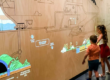
- interactive walls
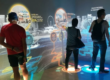
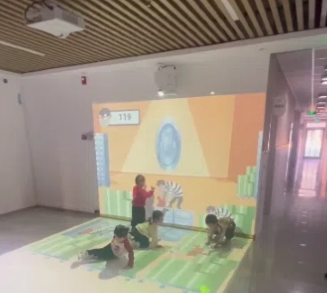
- floor projection systems
- digital museums
- projection mapping
- immersive exhibitions
- children’s interactive spaces
Advantages of LiDAR Systems
Strong Anti-Light Interference
Unlike cameras or infrared systems:
LiDAR performs much more reliably under:
- bright environments
- shopping mall lighting
- exhibition spotlights
- projection glare
- dynamic ambient light
This is one of the biggest reasons professional exhibition integrators now prefer LiDAR.
Low Latency
LiDAR systems provide:
- fast response
- smooth tracking
- real-time interaction feedback
Especially important for:
- projection football games
- immersive motion interaction
- gesture-triggered content
- multi-user interaction
Flexible Installation
PoE LiDAR systems simplify deployment significantly:
✅ Power + data through one cable
✅ Faster calibration
✅ Less environmental dependency
✅ Easier temporary installation
This matters enormously for:
- touring exhibitions
- event installations
- rapid deployment projects
Real Engineering Limitation
LiDAR is excellent for tracking —
but proper installation planning still matters.
Reflective glass, mirrors, and incorrect mounting angles can still affect tracking quality.
Professional environmental calibration remains important.
2. Infrared Touch Systems
Good for Controlled Indoor Environments
Infrared systems are common in:
- touch frames
- educational whiteboards
- small indoor displays
They are relatively affordable and simple for basic applications.
Advantages
✅ Lower hardware cost
✅ Mature technology
✅ Easy for small touch areas
Common Problems in Real Projects
Infrared systems often struggle with:
- sunlight interference
- projector light interference
- dead-angle issues
- frame alignment problems
- large-area instability
Especially in:
- large interactive walls
- immersive projection spaces
- bright exhibition environments
tracking accuracy can degrade quickly.
3. Camera Tracking Systems
Flexible — But Environmentally Sensitive
Camera-based systems use visual recognition and AI processing for interaction tracking.
They can create impressive demos.
But in real installations:
camera systems are usually the most environment-sensitive option.
Advantages
✅ Rich gesture recognition
✅ Multi-person analysis
✅ Advanced AI possibilities
Real Engineering Challenges
In actual deployment environments:
camera systems are heavily affected by:
- lighting changes
- shadows
- occlusion
- projector brightness
- background complexity
- CPU/GPU processing load
This often creates:
- unstable interaction
- delayed response
- inconsistent recognition
Especially in crowded public environments.
Real-World Comparison
Accuracy
LiDAR
Very stable in large interactive spaces.
Infrared
Good for small fixed touch zones.
Camera
Can vary significantly depending on lighting and environment.
Latency
LiDAR
Low latency, highly responsive.
Infrared
Generally fast.
Camera
Usually highest latency due to image processing.
Anti-Light Interference
LiDAR
Excellent.
Infrared
Weak under strong light.
Camera
Highly sensitive to environmental lighting.
Installation Complexity
LiDAR
Moderate, but fast after calibration.
Infrared
Simple for small installations.
Camera
Often requires significant environmental tuning.
Cost vs Long-Term Stability
This is where many buyers make mistakes.
Some systems appear cheaper initially —
but become expensive later due to:
- recalibration
- unstable operation
- maintenance time
- on-site debugging
- client complaints
In professional immersive projects:
stable interaction often matters more than lowest hardware cost.
Real Engineering Advice:
“Demo Effect” vs “Daily Stability”
A system that works well for:
- 5-minute demonstrations
may fail during:
- 10-hour exhibition operation
- crowded environments
- changing lighting conditions
- continuous public interaction
Professional integrators evaluate systems differently from demo videos.
Long-term stability matters more than visual marketing effects.
Which Technology Is Best?
Choose LiDAR If You Need:
✅ Immersive interaction
✅ Large-area tracking
✅ Projection mapping
✅ Stable low latency
✅ Strong anti-light performance
✅ Multi-user interaction
✅ Fast deployment
Choose Infrared If You Need:
✅ Small indoor touch areas
✅ Basic touch interaction
✅ Lower-cost installations
Choose Camera Systems If You Need:
✅ AI gesture recognition
✅ Advanced body tracking
✅ Experimental creative interaction
and can tolerate higher environmental sensitivity.
Common Search Terms Buyers Use
This topic is often searched as:
- LiDAR vs infrared touch
- LiDAR vs camera tracking
- best interactive projection technology
- interactive wall tracking system
- projection mapping touch system
- immersive exhibition interaction sensor
- LiDAR for interactive walls
- camera vs LiDAR for projection mapping
FAQ
Is LiDAR more accurate than infrared?
For large immersive environments:
usually yes.
Especially under complex lighting conditions.
Why do camera systems often feel delayed?
Because image processing introduces:
- recognition latency
- environmental dependency
- CPU/GPU processing overhead
especially in crowded scenes.
Is infrared still useful?
Absolutely.
For small indoor touch systems, infrared remains cost-effective and simple.
Why are immersive projects increasingly using LiDAR?
Because modern immersive spaces require:
- stable tracking
- anti-light interference
- large-area coverage
- real-time interaction
which LiDAR handles very effectively.
Final Engineering Advice
Choosing an interaction system is not only about:
what looks impressive in demos.
It’s about:
what remains stable after months of real operation.
In immersive environments:
tracking stability defines user experience.
That’s why more professional integrators are shifting toward PoE LiDAR-based interaction systems.
About CPJROBOT
CPJROBOT is a professional PoE LiDAR manufacturer focused on:
- immersive interaction systems
- interactive wall & floor solutions
- projection mapping interaction
- museum & exhibition installations
- Unity / TouchDesigner integration
- multi-LiDAR deployments
Our products are designed for real engineering environments —
where stable interaction matters more than laboratory demonstrations.